
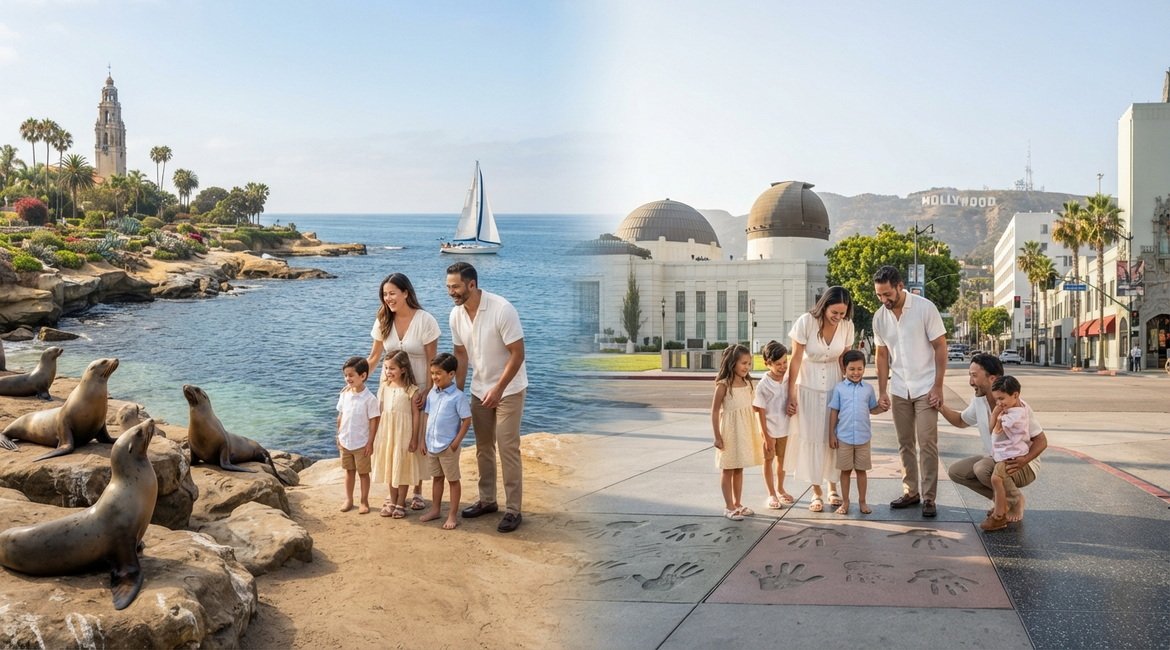
Los Angeles and San Diego are two of Southern California’s most popular family destinations, but they create very different vacations. Los Angeles offers enormous variety. Families can combine movie-related attractions, major museums, science exhibits, beaches, city neighborhoods and large entertainment days within one trip. San Diego feels more compact and coastal. Beaches, Balboa Park, the San Diego Zoo, Mission Bay and family attractions can be combined into a trip that generally requires less movement across a huge metropolitan area. Neither city works for every family in exactly the same way. A family that wants a slower vacation built around animals, parks and beaches may plan San Diego very differently from a family excited about movies, major attractions, museums and the scale of Los Angeles. The key is understanding how each destination fits your children’s ages, your transportation plans and the pace you want for the trip.
San Diego vs Los Angeles for Families at a Glance
The biggest difference is not the number of attractions. It is how the vacation feels from day to day. San Diego makes it relatively easy to alternate a major attraction with a beach, park or slower waterfront afternoon. Los Angeles provides a much larger menu of experiences, but attractions are spread across a much larger urban area.
| Family Priority | San Diego | Los Angeles |
|---|---|---|
| Overall atmosphere | Relaxed, coastal | Large, energetic, varied |
| Beaches | Easy to make central to trip | Excellent but location matters |
| Animals | Major part of destination | Several options |
| Museums | Many concentrated in Balboa Park | Greater variety across city |
| Big entertainment days | Several choices | Major strength |
| Daily logistics | Generally simpler | Requires geographic planning |
| Typical family stay | 3–5 days | 4–6 days |
Instead of asking which city is universally better, think about which type of daily schedule sounds easier for your family.
Which City Is Easier for a Family Vacation?
San Diego often feels easier to organize because many family activities fit naturally into a coastal vacation. Balboa Park alone contains the San Diego Zoo, museums, gardens and open spaces. Families can devote an entire day to the area without repeatedly moving across the city. Beach neighborhoods such as La Jolla, Coronado and Mission Bay can then provide slower days. Los Angeles requires more geographic planning. Griffith Park, Santa Monica, Exposition Park, Hollywood and other major visitor areas can be far apart. That does not make Los Angeles difficult for families, but it makes itinerary design more important. A successful Los Angeles family trip usually groups attractions by neighborhood instead of choosing unrelated attractions from across the city each day.
Family Attractions
San Diego’s family attractions fit together unusually well. Balboa Park can combine the San Diego Zoo with museums, gardens and open spaces. La Jolla adds coastal scenery and marine-focused experiences. Mission Bay provides room for slower outdoor days, while Coronado can become a simple beach-and-walking day. Los Angeles offers a broader range. Griffith Observatory introduces astronomy and science while providing city views. Griffith Park adds outdoor space nearby. Exposition Park concentrates several family-friendly cultural attractions in one area, while the coast provides Santa Monica and other beach destinations. The difference is concentration. San Diego allows families to find several different activities within one compact destination such as Balboa Park. Los Angeles rewards families who carefully build each day around one part of the city.
Theme Parks & Big Entertainment Days
Los Angeles and the surrounding Southern California region provide particularly strong options when a family wants a large entertainment-focused day. Universal Studios Hollywood combines a working entertainment destination with rides and attractions and can occupy most or all of a day. Disneyland Resort is another major family destination, although it is in Anaheim rather than Los Angeles itself. That geographic distinction matters when choosing accommodation and building an itinerary.

San Diego also has major entertainment attractions. LEGOLAND California is in Carlsbad, north of central San Diego, and is particularly oriented toward families with younger children. SeaWorld San Diego provides another full-day attraction around Mission Bay. The important planning question is how many large ticketed days your family actually wants. Children may enjoy a beach or park day more after a full day at a major attraction than another packed schedule the following morning.
Zoos, Aquariums & Animals
Animals are one of San Diego’s biggest family strengths. The San Diego Zoo occupies about 100 acres within Balboa Park and can easily fill most of a day. The San Diego Zoo Safari Park is a separate attraction near Escondido, roughly 30 miles northeast of Downtown San Diego. Because they are separate destinations, families should not plan them as if they were two sections of the same park.
Birch Aquarium at Scripps provides a smaller marine-focused experience in La Jolla and can fit naturally into a coastal day. Los Angeles has its own animal attractions, including the Los Angeles Zoo. The Aquarium of the Pacific in Long Beach is another significant Southern California option, although Long Beach is a separate destination south of central Los Angeles. Families particularly interested in animals can therefore build strong itineraries in either region, but San Diego makes wildlife attractions especially central to the overall visitor experience.
Beaches With Kids
Both destinations provide excellent beaches, but the experience is different. San Diego has about 70 miles of coastline across the region, with beaches ranging from the broad sand of Coronado to La Jolla’s coves and Mission Bay’s calmer waterfront areas. That variety makes it easy to build several coastal experiences into the same family trip.
Los Angeles also has excellent family beach options. Santa Monica combines a broad beach with the famous pier and nearby services. Travel north and Malibu provides more dramatic coastal scenery. South Bay communities such as Manhattan Beach offer a different beach-town atmosphere. For Los Angeles families, the key consideration is distance. If your hotel is near Hollywood or Downtown, a beach day becomes a separate part of the itinerary. If you stay in Santa Monica, the beach can become part of your everyday routine. San Diego can make that combination easier because many popular family itineraries already place significant emphasis on the coast.
Museums & Educational Activities
San Diego’s major advantage is concentration. Balboa Park contains numerous museums within the same general area, including institutions focused on science, natural history, transportation, art and culture. Families can select one or two museums without needing to cross the city between them. Los Angeles provides tremendous museum variety, but the institutions are distributed across different neighborhoods. Exposition Park is one useful exception. The California Science Center and Natural History Museum of Los Angeles County can be combined geographically.
Griffith Observatory provides another educational experience with astronomy exhibits and panoramic city views. Families interested in movies and filmmaking can add entertainment-related museums and attractions elsewhere in Los Angeles. Los Angeles provides more variety; San Diego often makes museum days easier to organize.
Which Is Better With Toddlers?
Families traveling with toddlers should think less about the number of famous attractions and more about the rhythm of each day. San Diego can make slower schedules relatively easy. Mission Bay provides open waterfront spaces, Balboa Park has gardens and lawns, and beach neighborhoods can create days where the family does not need to move between multiple major attractions.

Los Angeles can also work extremely well with young children when the itinerary is geographically focused. Griffith Park provides outdoor space, while the California Science Center and Natural History Museum can create an Exposition Park family day. Santa Monica can become another self-contained day built around the beach and surrounding area. In either city, avoid scheduling several distant attractions on the same day. With younger children, reducing transportation time can be more valuable than adding another famous attraction.
Which Is Better With Older Kids & Teens?
Older children and teenagers may appreciate the enormous variety available around Los Angeles. A family can move between movie-related attractions, science, city neighborhoods, beaches, museums and major entertainment experiences over several days. That diversity can be useful when family members have very different interests. San Diego remains highly appealing for older kids as well. The zoo and Safari Park work across age groups, while beaches, La Jolla and other outdoor areas create opportunities to balance attractions with time outside.
For teens who enjoy large cities and entertainment, Los Angeles may provide more variety. For families who want to combine major attractions with a more relaxed coastal pace, San Diego may fit the schedule more naturally.
Getting Around as a Family
Transportation creates one of the biggest practical differences between the two destinations. Los Angeles is geographically enormous. Driving can be useful when traveling with children and carrying beach equipment, strollers or other family gear, but traffic and parking need to be built into the itinerary. Metro can handle selected trips. As of September 2026, LA Metro’s rail network consists of six lines and 115 stations. The E Line reaches Santa Monica, the B Line serves Hollywood and Universal City, and other rail lines connect additional parts of the region. San Diego also benefits from public transportation, including the Trolley and bus network. The Trolley is particularly useful around Downtown and several major corridors. However, popular family destinations such as beaches and the Safari Park may still require buses, driving or other transportation.
Neither destination requires families to use only one form of transportation. A practical trip can combine public transit, walking and occasional car or rideshare trips according to each day’s destination.
Which Is Easier Without a Car?
San Diego can be relatively straightforward without a car if your family stays Downtown and builds the itinerary around transit-accessible destinations. The Trolley provides useful connections, and central attractions can be combined with buses and walking. The situation changes if you stay in a beach neighborhood and want to visit attractions spread across the region. Los Angeles has a larger rail network, but the city is also far larger. A carefully chosen hotel can make a major difference. Families staying near the E Line can reach Santa Monica and central destinations more easily, while a Hollywood-area base provides useful connections to several major attractions. The mistake in either city is assuming that public transportation reaches every attraction equally well. Plan the actual routes from your accommodation before deciding to make the entire vacation car-free.
Family Accommodation
San Diego offers several styles of family accommodation. Mission Bay works particularly well for families who want resort-style properties and water nearby. Coronado provides a quieter seaside atmosphere. La Jolla combines beaches with restaurants and coastal scenery, while Downtown is useful for sightseeing and public transportation. Los Angeles requires families to choose accommodation according to geography. Santa Monica works well when the coast is important. Hollywood can be practical for attractions in that section of the city. Downtown can simplify access to transit and selected museums, while other neighborhoods may work better for specific itineraries.
In both cities, check parking charges when comparing hotel prices if you plan to rent a car. A slightly cheaper room can become more expensive once daily parking and transportation are included.
Family Vacation Costs
There is no reliable rule that one city is always cheaper than the other. Accommodation rates change according to season, neighborhood, weekends, holidays and major events. The same is true for attraction tickets. Instead of comparing only hotel prices, build a realistic daily budget. Include accommodation, parking, transportation, attraction tickets and meals. San Diego families may spend heavily on major attractions such as the zoo or other ticketed destinations but can balance those days with beaches, parks and coastal sightseeing. Los Angeles has several major ticketed attractions but also provides free experiences such as beaches, Griffith Observatory general admission and permanent galleries at the California Science Center. Transportation can become a larger hidden expense in Los Angeles when an itinerary repeatedly crosses the city. The most effective budget strategy in either destination is to mix expensive attraction days with beaches, parks and free sightseeing.
How Many Days Does a Family Need?
Three days in San Diego can cover a focused selection of highlights. Four to five days provides a more comfortable family trip because it creates room for a major attraction, Balboa Park, coastal sightseeing and at least one slower beach day. Los Angeles generally benefits from slightly more time because of its size. Four days can provide a useful introduction, but five or six days allows families to explore several areas without spending every day rushing between attractions.
| Trip Style | San Diego | Los Angeles |
|---|---|---|
| Quick visit | 2–3 days | 3 days |
| First family trip | 3–5 days | 4–6 days |
| Relaxed vacation | 5–7 days | 6–7 days |
Families planning multiple theme parks or day trips should add additional days rather than trying to fit them into an already full itinerary.
Can You Visit Both With Kids?
Yes. San Diego and Los Angeles work naturally as part of the same Southern California trip. Downtown Los Angeles and Downtown San Diego are roughly 120 road miles apart. Under favorable conditions, the drive can take around two hours, but Southern California traffic can make it considerably longer. Families can also travel between the cities by train, depending on current schedules and service conditions. A seven-day trip is possible, although it requires selecting attractions carefully. Nine or ten days provides a more relaxed experience if you want several major attractions plus beach time in both destinations. With only four or five days total, choosing one city usually allows a deeper and less rushed family trip.
Sample 7-Day Family Itinerary
A seven-day itinerary works best when you resist the temptation to include every major Southern California attraction. Spend the first half of the trip around Los Angeles and the second half around San Diego.
Day 1: Griffith Park & Griffith Observatory
Begin with a relatively flexible Los Angeles day. Explore Griffith Park and finish around Griffith Observatory for exhibits and views across the city. This creates a lighter first day after traveling.
Day 2: Major Los Angeles Attraction
Choose one major entertainment attraction rather than attempting to combine several distant destinations. A full attraction day can be tiring for children, so keep the evening simple.
Day 3: Santa Monica & the Coast
Slow the pace with a beach day. Spend time around Santa Monica Beach and the waterfront, leaving room for an unstructured afternoon.
Day 4: Travel to San Diego
Transfer to San Diego and avoid building a complicated sightseeing schedule around the travel day. After checking in, explore the waterfront or spend a few hours near the beach.
Day 5: San Diego Zoo & Balboa Park
Give the San Diego Zoo most of the day. If the family still has energy afterward, explore part of Balboa Park rather than traveling to another section of the city.
Day 6: La Jolla & the Coast
Spend the day around La Jolla. Combine coastal scenery with a beach or another family attraction in the area.
Day 7: Coronado or Mission Bay
Finish with a slower day. Choose Coronado for a broad Pacific beach and seaside atmosphere or Mission Bay for parks, water and a relaxed family setting. This schedule deliberately alternates larger attractions with slower outdoor days. That rhythm can be much easier for families than seven consecutive days of major ticketed attractions.
San Diego or Los Angeles: How Families Can Choose
Choose based on what your family wants the vacation to feel like. San Diego suits a trip built around beaches, animals, parks and a more relaxed daily rhythm. It is particularly convenient when you want to alternate a major attraction with a slower coastal day. Los Angeles suits families that want maximum variety. Movies, large entertainment attractions, museums, science, city neighborhoods and beaches can all fit into one trip if you are willing to plan carefully around geography. Families with younger children may value San Diego’s ability to create simpler days around one area. Families with older children and teenagers may appreciate the range of very different experiences available across Los Angeles. But age alone should not decide the trip. A child fascinated by animals may be particularly excited by San Diego, while a younger child interested in movies or a specific Los Angeles attraction may enjoy LA more. Build the destination around your family’s interests rather than trying to identify a universal winner.
FAQ
Is San Diego or Los Angeles easier with kids?
San Diego often allows families to build simpler days around beaches, Balboa Park and animal attractions. Los Angeles provides greater variety but requires more attention to distances and transportation between neighborhoods.
Which has better beaches for families?
Both regions have excellent family beaches. San Diego makes coastal time particularly easy to integrate into a family vacation through areas such as Coronado, La Jolla and Mission Bay. Los Angeles offers Santa Monica, South Bay beaches and Malibu, but travel time depends heavily on where you stay.
Which city has more attractions for kids?
Los Angeles and the surrounding region provide an exceptionally broad variety of entertainment, museums and city experiences. San Diego has a particularly strong concentration of animal attractions, beaches and family activities around Balboa Park and the coast.
Can families visit Los Angeles and San Diego in one trip?
Yes. A seven-day trip can include both if the itinerary is selective, while nine or ten days provides a more comfortable pace. Families should allow sufficient time for the transfer and avoid scheduling a major attraction immediately after a long travel day.
How many days should families spend in each city?
Three to five days works well for many first family trips to San Diego. Los Angeles generally benefits from four to six days because major attractions and neighborhoods are spread across a much larger area.
Recommended Next Steps
Start by asking each family member to choose the two or three experiences they care about most. If the resulting list revolves around the San Diego Zoo, animals, Balboa Park, La Jolla and beach time, build the trip around San Diego. If it revolves around movies, major entertainment attractions, museums, Griffith Observatory and several very different neighborhoods, build the trip around Los Angeles. For families planning both cities, avoid treating the vacation as a race through Southern California. Seven days is enough for a selective introduction, but nine or ten days creates much more room for slower beach days and rest between major attractions. In San Diego, three to five days works well for a first family visit. In Los Angeles, four to six days makes the city’s geographic scale easier to manage. Whichever destination you choose, group attractions geographically and alternate demanding attraction days with beaches, parks or shorter sightseeing days. The biggest difference between San Diego and Los Angeles is not whether either city is family-friendly. Both are. The difference is the type of family vacation they create: San Diego naturally combines major attractions with a coastal rhythm, while Los Angeles provides a much larger range of experiences spread across a much larger city.