
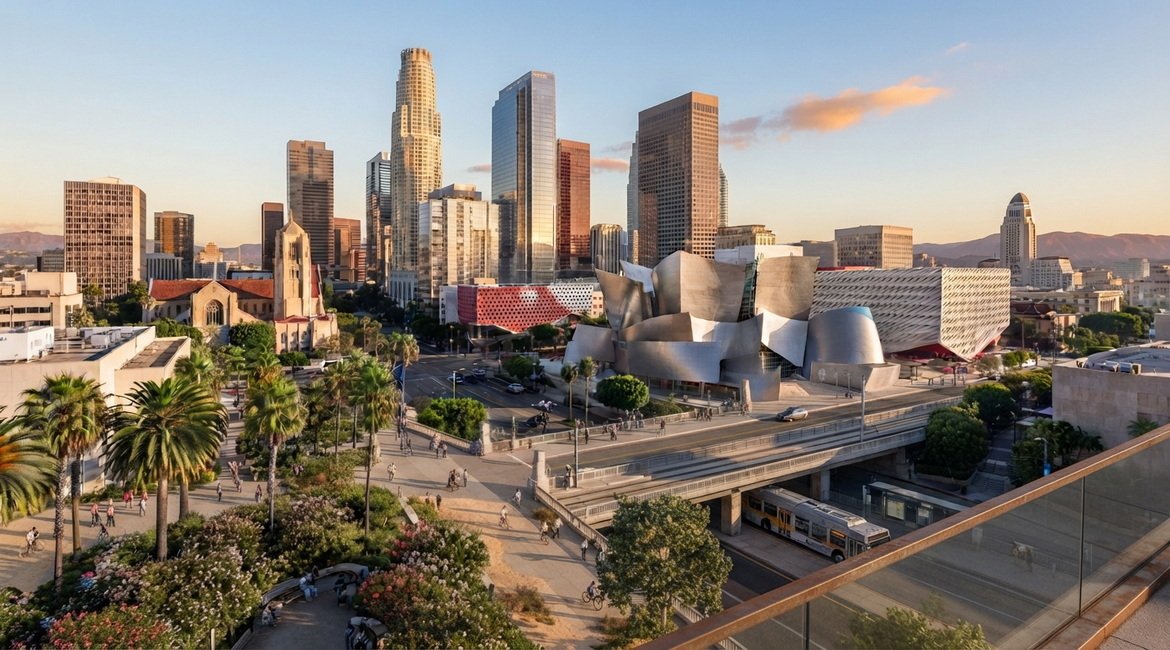
Los Angeles has a reputation as a city where everyone needs a car. For many trips, however, that is no longer completely true. A visitor who chooses accommodation near useful Metro lines and groups attractions geographically can explore a surprising amount of Los Angeles using trains, buses, walking and occasional rideshares. The key is choosing the right neighborhood. Staying several miles from a useful Metro station can make a car-free vacation frustrating. Staying within a short walk of a well-connected station can completely change the experience. For most visitors traveling without a car, Santa Monica, Hollywood, Downtown Los Angeles and Koreatown are among the most practical places to consider.
Can You Stay in Los Angeles Without a Car?
Yes, but the experience depends heavily on your itinerary. Los Angeles is enormous, and public transportation does not make every attraction equally convenient. A beach-focused traveler staying in Downtown Santa Monica can walk to restaurants, the beach and the pier while using the Metro E Line for trips toward central Los Angeles. Someone interested in Hollywood and Universal Studios can stay near the Metro B Line and reach several major attractions without driving. Downtown Los Angeles provides the largest concentration of rail connections and makes a particularly useful base for visitors interested in museums, architecture and neighborhoods connected by Metro. The mistake is assuming that being somewhere in Los Angeles automatically means you can easily reach everywhere else. For a car-free vacation, your accommodation should be selected around the attractions you expect to visit most often.
Best Areas at a Glance
| Area | Works Well For | Main Transportation Advantage |
|---|---|---|
| Santa Monica | Beaches, families, first-time visitors | E Line + walkability |
| Hollywood | Hollywood, Universal, Griffith area | B Line |
| Downtown LA | Transit, museums, culture | Multiple rail lines |
| Koreatown | Food, central location, value | B & D Lines |
| West Hollywood | Dining, central sightseeing | Bus + rideshare |
| Culver City | Balanced city/coast trip | E Line |
There is no universal winner. The best neighborhood is the one that minimizes transportation for your particular trip.
1. Santa Monica
Santa Monica is one of the easiest choices for travelers who want a Los Angeles vacation to include substantial beach time. Downtown Santa Monica is compact compared with most of Los Angeles. The beach, Santa Monica Pier, restaurants and shopping are concentrated within a relatively walkable area. The Downtown Santa Monica station is the western terminus of the Metro E Line, providing rail service toward Culver City, Exposition Park and Downtown Los Angeles.
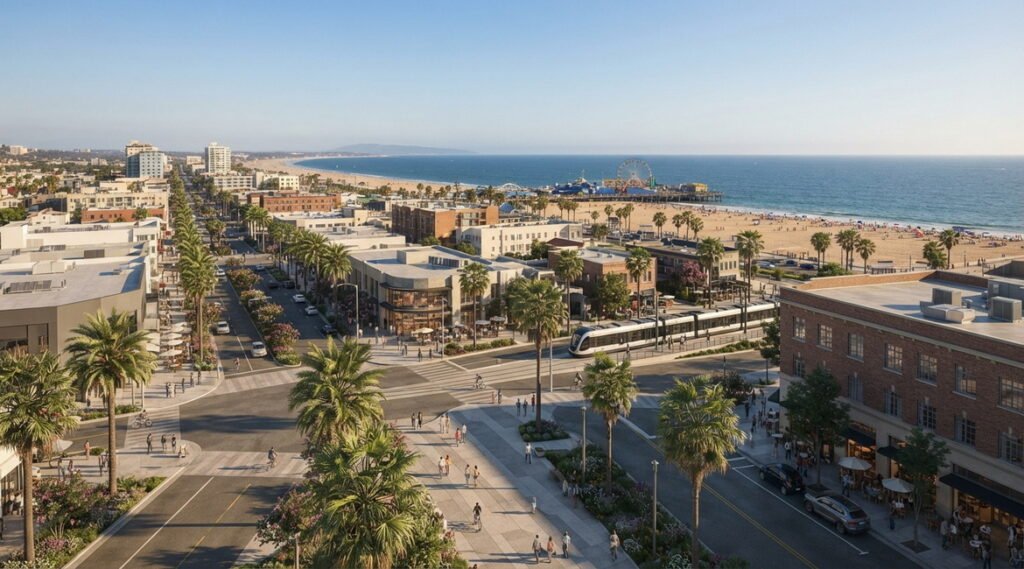
That combination makes Santa Monica especially appealing for travelers who want days when they barely need transportation at all. Wake up, walk to breakfast, spend time on the beach, explore the waterfront and have dinner nearby. The disadvantage is location. Santa Monica sits on the western edge of the Los Angeles area, so trips to Hollywood, Universal Studios and other inland attractions can take considerable time. Choose Santa Monica if the coast is one of your highest priorities rather than simply because it looks convenient on a map.
Who Should Stay in Santa Monica?
Santa Monica works particularly well for first-time visitors who want a beach-oriented vacation, families who value a relatively walkable daily environment and travelers who prefer having restaurants and activities close to their hotel. It is less convenient if most of your itinerary is centered around Hollywood, Universal Studios and inland Los Angeles.
2. Hollywood
Hollywood is one of the most practical areas for a sightseeing-focused trip without a car. The Metro B Line has stations along Hollywood Boulevard, including Hollywood/Western, Hollywood/Vine and Hollywood/Highland. That creates direct rail connections toward Downtown Los Angeles in one direction and Universal City in the other.
Many famous Hollywood attractions are concentrated around Hollywood Boulevard and can be explored on foot once you arrive. Universal Studios Hollywood is also unusually convenient from this part of the city compared with many other Los Angeles attractions. Hollywood is less convenient for the beach. Reaching Santa Monica requires additional travel and is much less straightforward than staying along the E Line. For a first visit centered around classic Los Angeles sightseeing rather than daily beach time, Hollywood can still be an efficient base.
3. Downtown Los Angeles
Downtown Los Angeles offers the strongest concentration of Metro connections. Depending on the station, travelers can connect with rail services running toward Hollywood, Santa Monica, Long Beach, East Los Angeles and other parts of the region. The Regional Connector also makes it possible for the A and E Lines to travel through Downtown without requiring the transfers that were previously necessary.
Downtown itself contains museums, architecture, historic areas, cultural attractions and restaurants. That means some days can be spent mostly on foot once you reach the part of Downtown you want to explore. Another advantage is Union Station. It functions as an important transportation hub and also offers the FlyAway bus connection to LAX. Downtown is not the best choice for everyone. Travelers dreaming primarily about the Pacific Ocean may prefer Santa Monica, while visitors concentrating on Universal Studios and Hollywood may find Hollywood more convenient. For a transportation-focused itinerary involving multiple parts of Los Angeles, however, Downtown deserves serious consideration.
4. Koreatown
Koreatown offers an interesting compromise between location, transportation and neighborhood life. It sits west of Downtown and south of Hollywood, putting it in a relatively central position for many sightseeing itineraries. The neighborhood is served by Metro rail, including the D Line along Wilshire Boulevard and connections with the B Line at Wilshire/Vermont. The D Line became more useful for visitors in 2026 with the opening of new stations extending service west to Wilshire/La Cienega.
Koreatown also has a dense collection of restaurants and businesses, reducing the need to travel elsewhere for every meal. It is a practical choice for travelers who care more about central positioning and food than staying beside a major tourist landmark. If you choose Koreatown specifically for public transportation, stay close to a rail station rather than simply booking anywhere with a Koreatown address. A difference of several blocks can matter when you are walking to transit every day.
5. West Hollywood
West Hollywood deserves an important qualification. It can be convenient without a car, but not because it has the same direct rail access as Downtown, Hollywood or Santa Monica. The area works because restaurants, shops and entertainment are relatively concentrated, while buses and rideshares can handle longer journeys. For travelers who expect to combine walking with occasional rideshares, West Hollywood can provide a useful central base.
It is particularly well positioned for trips involving Museum Row, Beverly Hills, Hollywood and other central-western parts of Los Angeles. The disadvantage becomes clear if your goal is a rail-focused trip. Unlike Hollywood, Downtown, Koreatown and Santa Monica, West Hollywood does not currently have a Metro Rail station. A future K Line northern extension is planned to improve rail connections through this part of Los Angeles, but that project is still years away. For a 2026 trip, think of West Hollywood as a walking + bus + rideshare base rather than a Metro Rail base.
6. Culver City
Culver City is worth considering for travelers who want to divide their trip between central Los Angeles and the coast. The Metro E Line runs through the area on its route between Downtown Los Angeles and Santa Monica. That gives Culver City a useful geographic advantage. You can travel west toward the beach or east toward Exposition Park and Downtown without relying entirely on rideshares.
Culver City itself also has restaurants and a walkable central district. The tradeoff is that it does not place you directly beside the beach or the classic Hollywood attractions. It works better as a balanced transportation base than as a destination chosen for one famous landmark.
Which Area Is Best for First-Time Visitors?
For first-time visitors without a car, start by deciding whether your trip is primarily coastal or sightseeing-focused. Choose Santa Monica if walking to the Pacific Ocean every day is an important part of the vacation. Choose Hollywood if Universal Studios, Griffith Park and Hollywood attractions dominate the itinerary. Choose Downtown Los Angeles if public transportation connections and cultural attractions matter most. Koreatown can be particularly useful for travelers looking for a more central base with strong food options and useful rail connections. Culver City provides a compromise for travelers who want reasonable access to both central Los Angeles and Santa Monica.
| Your Priority | Area to Consider |
|---|---|
| Beach & walkability | Santa Monica |
| Hollywood & Universal | Hollywood |
| Maximum rail connections | Downtown LA |
| Central location & food | Koreatown |
| Central location + rideshares | West Hollywood |
| City + beach balance | Culver City |
Where to Stay Without a Car With Kids
Families have slightly different priorities. Being able to walk to breakfast, dinner and at least one major activity can be more valuable than having the theoretically fastest connection to every part of Los Angeles. Santa Monica is particularly practical for families who want the beach to be a major part of the trip. Children can spend time at the beach, the waterfront and nearby attractions without requiring transportation every time the family leaves the hotel.
Hollywood can make more sense when Universal Studios is the family’s main attraction. For museum-focused family trips, locations with convenient connections toward Exposition Park can also work well. The most important rule with children is avoiding unnecessarily long daily commutes.
Where to Stay for the Beach
For a car-free beach-focused trip, Santa Monica is the most straightforward area in this guide. You can walk to the Pacific, restaurants and shops while retaining access to the Metro E Line. Venice Beach is another possibility if your trip will remain heavily focused on the coast. However, Venice does not have the same direct rail connection as Downtown Santa Monica.
That difference matters when you want to explore central Los Angeles. Staying close to Downtown Santa Monica provides a better combination of beach access and rail transportation.
Where to Stay for Universal Studios
Hollywood is particularly convenient for Universal Studios Hollywood without a car. The Metro B Line connects Hollywood stations with Universal City/Studio City station. From the station area, visitors can use the pedestrian connection and available shuttle service toward the theme park complex. This makes Universal one of the easier major Los Angeles attractions to incorporate into a car-free itinerary. Staying around Hollywood also leaves you relatively well positioned for Griffith Park and other central Los Angeles attractions. If Universal is the main purpose of the trip, accommodation around Universal City itself is another option.
Where to Stay for Museums & Sightseeing
The answer depends on which museums you want to visit. Downtown Los Angeles works well for Downtown cultural institutions and provides strong transportation connections to other parts of the city. Koreatown has become more useful for Museum Row because the Metro D Line now extends west along Wilshire Boulevard to Wilshire/La Cienega. For the California Science Center and Natural History Museum in Exposition Park, the Metro E Line provides convenient rail access. Culver City and Downtown are both positioned along that line. The important lesson is that Los Angeles does not have one central museum district containing everything. Choose your base according to the attractions that matter most.
How to Get Around Los Angeles Without a Car
A realistic car-free Los Angeles trip normally uses several forms of transportation rather than relying on one. Metro Rail handles many longer journeys. As of 2026, the rail system consists of six lines and more than 100 stations. The B Line connects Downtown with Hollywood and North Hollywood. The E Line connects East Los Angeles and Downtown with Culver City and Santa Monica. The D Line serves the Wilshire corridor, while the A, C and K Lines expand access to other parts of the region. Buses fill many of the gaps between rail stations. Walking works well within individual neighborhoods but is rarely practical between distant Los Angeles areas. Rideshares can be useful for the final part of a journey or for attractions where transit connections would require excessive time. The most efficient strategy is often Metro for major journeys, walking within neighborhoods and occasional rideshares for difficult connections.
Getting From LAX Without a Car
Airport transportation became easier with the opening of the LAX/Metro Transit Center. As of September 2026, both the C and K Lines serve the LAX/Metro Transit Center. Travelers transfer between the station and airport terminals using a free shuttle.
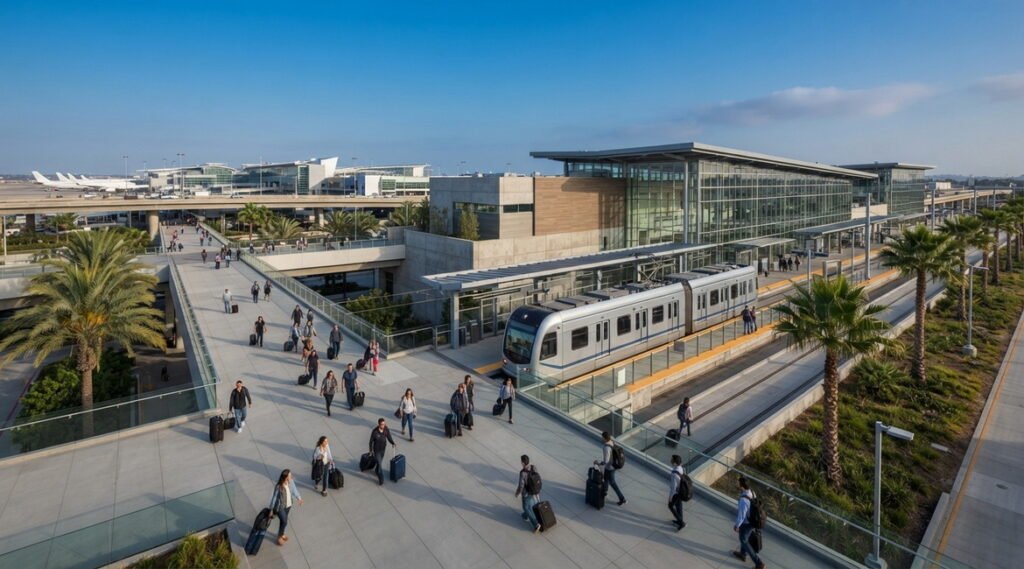
Another useful option is the FlyAway bus. Nonstop FlyAway service connects LAX terminals with Union Station, making it particularly useful for travelers staying Downtown or transferring to another transportation service there. The best airport route depends on your hotel. Do not automatically choose the same airport transfer for Santa Monica, Hollywood and Downtown.
Places That Are Harder to Visit Without a Car
A car-free trip is possible, but it helps to recognize the limitations. Malibu is considerably less convenient than Santa Monica for visitors relying on public transportation. The Getty Center can be reached without a car, but it requires more planning than attractions directly beside rail stations. Griffith Observatory also requires an additional connection beyond the nearest rail service. Day trips outside the central Los Angeles transportation network can become even more complicated. If one difficult-to-reach destination is extremely important, compare the cost and time of a rideshare with the complexity of several transit connections. You do not need to rent a car for an entire vacation simply because one day is difficult by public transportation.
Tips for Choosing Your Hotel
For a car-free Los Angeles trip, the location of the hotel within a neighborhood matters almost as much as the neighborhood itself. A hotel advertised as being in Hollywood may still be much less convenient than another property a few minutes from a B Line station. The same applies to Koreatown and Culver City. Check the walking route between the hotel and the nearest useful station before booking. Also look at what is available immediately around the hotel. Restaurants, cafés, pharmacies and everyday services within walking distance make a car-free stay much easier. Think about your evenings as well. If you expect to return after dark, consider whether you are comfortable with the specific walking and transit route and use a rideshare when that is the more practical option. Finally, calculate transportation time rather than distance alone. A hotel that looks geographically central is not necessarily the hotel with the easiest transportation connections.
FAQ About Staying in LA Without a Car
Is Los Angeles possible without a car?
Yes. A car-free Los Angeles trip is realistic if you stay near useful Metro or bus connections and group attractions geographically. Some destinations remain less convenient by public transportation, so occasional rideshares can make the itinerary much easier.
What is the best area to stay in LA without a car?
It depends on your itinerary. Santa Monica works particularly well for beaches, Hollywood for Hollywood attractions and Universal Studios, Downtown LA for transportation connections, and Koreatown for a relatively central base with useful Metro access.
Is Santa Monica good without a car?
Yes. Downtown Santa Monica combines a walkable coastal environment with the western terminus of the Metro E Line. The beach, pier, restaurants and shopping can all be reached without needing a car for every trip.
Can you reach Universal Studios without a car?
Yes. The Metro B Line serves Universal City/Studio City station, making Universal Studios Hollywood one of the easier major attractions to reach by rail from Hollywood or Downtown Los Angeles.
Can you get from LAX to Los Angeles without a car?
Yes. The LAX/Metro Transit Center is served by the C and K Lines, with a free shuttle connecting the station and airport terminals. Nonstop FlyAway bus service also connects LAX with Union Station and Van Nuys.
Recommended Next Steps
Start by listing the five or six Los Angeles attractions that matter most to you. Then place them on a map before choosing accommodation. If most of your priorities are beaches and coastal activities, Downtown Santa Monica is one of the easiest places to build a car-free vacation. If Hollywood, Universal Studios and Griffith Park dominate the itinerary, staying near a B Line station in Hollywood can significantly simplify transportation. For a trip involving several different parts of Los Angeles, Downtown provides extensive rail connections, while Koreatown offers a useful central alternative. Culver City is worth considering when you want to split your time between Downtown, Exposition Park and the coast. West Hollywood can also work well, but plan on using buses and occasional rideshares because it does not currently have direct Metro Rail service. Most importantly, do not choose a hotel based only on the neighborhood name. For a trip without a car, being within a short, convenient walk of the transportation you will actually use can matter more than having a famous Los Angeles address.