
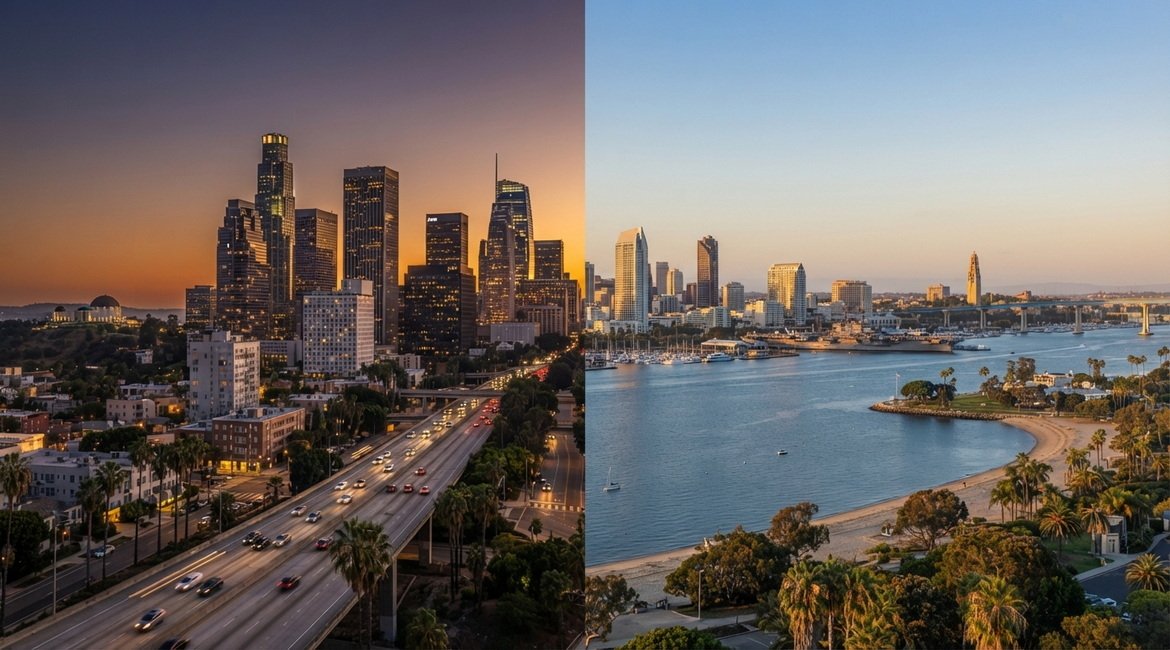
Los Angeles and San Diego offer two very different versions of a Southern California vacation. Los Angeles is enormous, energetic and packed with famous neighborhoods, entertainment attractions, museums, beaches and cultural experiences. A first visit can include Hollywood, Griffith Observatory, Santa Monica, major museums and theme parks, yet still leave large parts of the city unexplored. San Diego feels more compact from a visitor’s perspective. Beaches, Balboa Park, the San Diego Zoo, waterfront areas and coastal neighborhoods can be combined into a vacation that often feels slower and easier to organize. Neither city offers the same type of trip. The better fit depends on whether you want a large-city sightseeing vacation with enormous variety or a more coastal trip where beaches, outdoor time and major family attractions play a larger role.

Los Angeles vs San Diego at a Glance
The easiest way to understand the difference is to think about the overall style of each destination.
| Category | Los Angeles | San Diego |
|---|---|---|
| Overall feel | Huge, energetic, highly varied | Coastal, relaxed, easier to organize |
| Beaches | Santa Monica, Venice, Malibu and more | Long coastline with many beach neighborhoods |
| Major attractions | Movies, museums, neighborhoods, theme parks | Zoo, Balboa Park, beaches, waterfront |
| Family trip | Huge variety but more transportation | Strong concentration of family activities |
| Short trip | Requires strict priorities | Easier to structure |
| Typical first stay | 4–6 days | 3–5 days |
Los Angeles generally rewards travelers who enjoy variety and do not mind planning transportation carefully. San Diego suits travelers who want major attractions while keeping the Pacific coast and outdoor time at the center of the vacation.
Overall Travel Experience
Los Angeles feels less like one destination and more like a collection of cities and neighborhoods connected across a huge metropolitan area. Hollywood can feel completely different from Santa Monica. Downtown Los Angeles provides another experience, while Malibu, Koreatown, Venice and the museum districts add still more variety. That scale is part of the appeal. A traveler interested in movies, architecture, art, food, beaches and major entertainment attractions can build several completely different days without leaving the region. The tradeoff is transportation. You need to think about where attractions are located before planning each day. San Diego also has distinct neighborhoods, but many first-time itineraries feel more manageable. A visitor can combine Balboa Park, Downtown, the waterfront and several coastal neighborhoods without the same sense of trying to understand an enormous metropolitan region.
If you prefer a busy trip with a long list of different experiences, Los Angeles offers tremendous variety. If you prefer a vacation where sightseeing and beach time blend more naturally, San Diego provides a different rhythm.
Beaches & Coastline
Both cities offer excellent access to the Pacific Ocean, but the beach experience is different. Los Angeles has famous coastal destinations including Santa Monica, Venice and Malibu. Santa Monica combines a broad beach with a pier and an urban coastal district. Venice adds an active oceanfront environment, while Malibu provides a more scenic coastline with cliffs and stretches of beach farther from central Los Angeles. San Diego places the coast even more prominently within the visitor experience. The region has roughly 70 miles of coastline, with beach areas stretching from Coronado and Mission Beach to La Jolla and communities farther north.
Mission Beach combines sand with a boardwalk environment, while La Jolla adds cliffs, coves and dramatic coastal scenery. Coronado offers another classic beach setting across the bay from Downtown San Diego. Los Angeles provides famous individual coastal destinations within a much larger city trip. San Diego makes it easier to build several days where the coast itself is a central part of the itinerary.
Attractions & Sightseeing
Los Angeles has an enormous range of attractions. A first trip can include Griffith Observatory, Hollywood, the Getty, Santa Monica, museums, movie-related attractions and Universal Studios Hollywood. The difficulty is that these places are spread across the region. Seeing more attractions often means spending more time traveling between them. San Diego’s signature attractions include Balboa Park, San Diego Zoo, the waterfront, Old Town, coastal neighborhoods and major family attractions around the region. Balboa Park alone contains numerous museums, gardens, cultural institutions and the San Diego Zoo.
That concentration is useful for shorter trips. Instead of spending substantial time moving between attractions, visitors can devote a large part of a day to one area. Los Angeles provides greater geographic and experiential variety. San Diego provides a more concentrated sightseeing experience.
Which Is Better With Kids?
Both cities can support excellent family vacations, but the experience is different. Los Angeles provides families with an unusually broad selection. Universal Studios Hollywood, the California Science Center, Natural History Museum, Griffith Observatory, Los Angeles Zoo and beaches can create a trip where every day feels different. The challenge is transportation between them. Families need to group attractions geographically and avoid scheduling too much in one day. San Diego has several family attractions concentrated around areas that are relatively easy to combine. Balboa Park includes the San Diego Zoo as well as museums, gardens and family-oriented cultural attractions. The city’s beaches add easy outdoor days between larger attractions.

Families interested in animals can also build a larger Southern California itinerary around the San Diego Zoo and San Diego Zoo Safari Park. The practical decision often comes down to travel style. Choose your destination based on whether your children would enjoy a wider mix of entertainment, museums and city experiences or a trip with a stronger combination of animals, beaches and outdoor time.
Museums & Culture
Los Angeles has a larger and more geographically dispersed museum scene. The Getty Center combines art, architecture, gardens and city views. Museum Row includes several major institutions, while Downtown Los Angeles adds contemporary art, architecture and cultural venues. Exposition Park provides another useful cluster with the Natural History Museum and California Science Center. San Diego concentrates much of its museum experience inside Balboa Park. The park contains numerous museums covering subjects such as art, science, photography, transportation, natural history and cultural heritage. That makes San Diego especially convenient if you want to visit several cultural attractions without repeatedly crossing the city. Los Angeles offers enormous depth and variety. San Diego makes cultural sightseeing easier to combine with gardens, architecture and outdoor spaces.
Outdoor Activities & Nature
Southern California weather makes outdoor time important in both destinations. Los Angeles offers Griffith Park, the Santa Monica Mountains, coastal areas and numerous beaches. A single trip can combine city views from Griffith Park with a coastal afternoon in Santa Monica or Malibu. San Diego integrates nature and coastline into many of its most recognizable visitor areas. La Jolla combines coastal scenery with beaches and ocean views. Balboa Park provides gardens and open spaces alongside museums. Mission Bay adds another large waterfront recreation area.
The broader San Diego region also makes it easy to move between urban sightseeing and coastal scenery within the same vacation. For travelers whose ideal Southern California trip includes outdoor time every day, San Diego’s geography can make that style particularly easy to organize. Los Angeles, meanwhile, provides more contrast between dense urban neighborhoods, hills and the Pacific coast.
Getting Around
Transportation is one of the biggest differences between these trips. Los Angeles is geographically enormous. A hotel in Santa Monica may be convenient for the beach but far from Universal Studios. Staying in Hollywood improves access to Universal and Griffith Park but makes coastal days longer. The LA Metro Rail system has expanded considerably and, as of September 2026, includes six rail lines and 115 stations. The E Line reaches Santa Monica, the B Line connects Downtown with Hollywood and North Hollywood, and other lines connect additional parts of the county. Public transportation can therefore handle many tourist journeys, but a successful car-free itinerary still requires careful hotel selection. San Diego also has a light-rail system. The San Diego Trolley connects Downtown with areas including Old Town, Mission Valley, UC San Diego and other parts of the region.
However, many beach areas and attractions still require buses, rideshares or a car. In either city, transportation should be part of itinerary planning rather than something you decide after choosing a hotel.
Which Is Easier Without a Car?
Neither city should be treated as universally easy or difficult without a car. In Los Angeles, a traveler staying near the right Metro station can connect Downtown, Hollywood, Universal City, Exposition Park, Culver City and Santa Monica by rail. That makes certain itineraries surprisingly practical without driving. The problem appears when you add places such as Malibu or attractions far from convenient rail connections. San Diego’s visitor areas can feel more compact, particularly when staying Downtown and concentrating on the waterfront, Balboa Park and neighborhoods connected by transit. But coastal areas are spread across the region, and rail does not directly serve every beach visitors may want to explore. For either destination, a combination of public transportation, walking and occasional rideshares can work. If you rent a car, compare parking costs and hotel parking fees rather than looking only at the daily rental rate.
Costs & Accommodation
Both Los Angeles and San Diego can become expensive, particularly in desirable coastal areas. Hotel prices vary enormously by neighborhood, season, weekday and major events. Instead of comparing cities using one average hotel rate, calculate the total cost of the specific trip you are planning. A cheaper Los Angeles hotel far from your attractions can create additional transportation and parking costs. A more expensive Santa Monica hotel might reduce the need for transportation on beach-focused days. The same logic applies in San Diego. A well-located Downtown or coastal hotel may cost more per night but simplify parts of the itinerary. Families should also compare room size, breakfast options, parking, resort fees and whether nearby restaurants make meals easier. Theme parks and major ticketed attractions can have a much larger effect on the total vacation budget than small differences in hotel rates.
Which Is Better for a Weekend?
A weekend requires very different planning in the two cities. Los Angeles can work for two or three days, but you need strict priorities. A short first trip might use one day for Hollywood and Griffith Observatory and another for Santa Monica and the Westside. Trying to add Downtown, Malibu, museums and Universal Studios to the same weekend can make transportation dominate the experience. San Diego is easier to structure around a smaller number of geographic clusters. A short trip can combine Balboa Park, the waterfront and one coastal area without attempting to experience the entire region. For either destination, avoid treating a weekend as a shortened version of a seven-day itinerary. Choose two or three priorities and leave the rest for another visit.
How Many Days Do You Need?
Los Angeles generally benefits from additional time because of its size. Three days is enough for a focused introduction. Four to six days provides more flexibility for beaches, museums, Hollywood, Griffith Park and a major entertainment attraction without packing everything together. San Diego works well with three to five days for many first-time visitors. That provides enough time for Balboa Park, the zoo, Downtown or the waterfront and several coastal areas.
| Trip Length | Los Angeles | San Diego |
|---|---|---|
| 2 days | Very selective highlights | Compact introduction |
| 3 days | Focused first visit | Strong first visit |
| 4–5 days | Comfortable highlights trip | Relaxed city + coast trip |
| 6–7 days | Much broader exploration | Room for surrounding areas and slower days |
If you have a full week, combining the two cities becomes another strong option.
Best Time to Visit
Both destinations can be visited throughout the year. Spring and fall are especially useful for travelers who want comfortable sightseeing conditions while avoiding some of the busiest summer travel periods. Summer brings the strongest traditional beach-vacation atmosphere but can also bring larger crowds and higher demand in popular coastal areas. One Southern California detail surprises some first-time visitors: late spring and early summer mornings near the coast can be cloudy or gray even when inland areas are sunnier. That does not necessarily mean the entire day will remain cloudy. Winter can still work well for city sightseeing, museums and outdoor attractions, although Pacific Ocean water temperatures are cooler than many travelers expect from Southern California. Always check the forecast for your specific dates because coastal and inland conditions can differ significantly on the same day.
Can You Visit Los Angeles & San Diego on the Same Trip?
Yes. The two cities are close enough to combine naturally within a Southern California itinerary. Downtown Los Angeles and Downtown San Diego are roughly 120 road miles apart, although the exact distance depends on your starting and ending neighborhoods. Driving can take around two hours in favorable conditions, but Southern California traffic can make the journey considerably longer.
Rail is another option for travelers who do not want to drive. When planning the transfer, avoid treating it as if it takes no time. Hotel checkout, station or highway travel, breaks and checking into the next accommodation can consume a meaningful part of the day. For most first-time visitors, combining the cities makes the most sense when you have at least six or seven days.
Sample 7-Day Los Angeles & San Diego Itinerary
A one-week trip can provide a useful introduction to both destinations without changing hotels every night.
| Day | Plan |
|---|---|
| Day 1 | Arrive in Los Angeles + relaxed neighborhood exploration |
| Day 2 | Hollywood + Griffith Observatory |
| Day 3 | Getty or museums + Santa Monica |
| Day 4 | Travel from Los Angeles to San Diego + waterfront evening |
| Day 5 | Balboa Park + San Diego Zoo |
| Day 6 | La Jolla + coastal afternoon |
| Day 7 | Coronado or another San Diego beach + departure |
This itinerary deliberately avoids squeezing Universal Studios into the Los Angeles portion. If Universal is a major priority, replace one Los Angeles sightseeing day with a full park day or extend the trip. Families may also want to spend more time in San Diego if the zoo, beaches and other family attractions are central to the vacation.
Los Angeles or San Diego: How to Choose
Instead of looking for one city that is universally better, match the destination to the trip you actually want.
| If You Want… | Consider… |
|---|---|
| Hollywood & movie attractions | Los Angeles |
| A beach-centered vacation | San Diego |
| Huge museum & neighborhood variety | Los Angeles |
| Zoo + museums + beaches | San Diego |
| A large, energetic city trip | Los Angeles |
| A slower coastal itinerary | San Diego |
| Many different experiences in one region | Los Angeles |
| A one-week Southern California introduction | Combine both |
For a first trip, think about the two or three experiences you would be most disappointed to miss. If those experiences are Hollywood, major entertainment attractions, famous museums and a large-city atmosphere, build the trip around Los Angeles. If they are beaches, Balboa Park, the zoo, coastal scenery and a more relaxed pace, build the trip around San Diego. If both lists sound equally appealing and you have a week or longer, dividing the vacation between the cities can provide a broader introduction to Southern California.
FAQ About Los Angeles vs San Diego
Is Los Angeles or San Diego better for a first California trip?
It depends on the type of trip you want. Los Angeles offers enormous variety, including Hollywood, museums, entertainment attractions and beaches. San Diego combines major attractions with a stronger coastal focus and can be easier to organize for a shorter vacation.
Which city has better beaches?
Both have excellent Pacific beaches. Los Angeles offers famous destinations such as Santa Monica, Venice and Malibu, while San Diego has a long coastline with areas such as Coronado, Mission Beach and La Jolla. San Diego can be easier for travelers who want beaches to be a central part of several vacation days.
Which city is easier with kids?
San Diego offers a convenient combination of beaches, Balboa Park, the San Diego Zoo and other family attractions. Los Angeles provides a wider variety of entertainment, science, museums and beaches but usually requires more transportation planning. The better fit depends on your children’s interests and the pace you prefer.
Can you visit both cities in one week?
Yes. Seven days allows a useful introduction to both cities. One practical approach is three days in Los Angeles, one transfer day with some sightseeing, and three days in San Diego. Add extra days if theme parks or slower beach days are important.
How far is San Diego from Los Angeles?
Downtown Los Angeles and Downtown San Diego are roughly 120 road miles apart. Driving may take around two hours in favorable conditions, but traffic can increase the journey considerably. Travelers can also consider rail instead of driving.
Recommended Next Steps
Start with the experiences that matter most rather than choosing between Los Angeles and San Diego based only on their names. For a Los Angeles-focused trip, allow enough time to divide the city into geographic areas. Hollywood and Griffith Park can form one day, museums another, and Santa Monica and the coast another. For a San Diego-focused trip, build the itinerary around Balboa Park, the waterfront and one or two coastal areas such as La Jolla, Mission Beach or Coronado. Three days can provide a useful introduction to either destination, although Los Angeles generally benefits from additional time because its attractions are spread across a much larger area. With four or five days, either city can support a more relaxed first visit. With seven days or longer, consider combining them instead of forcing yourself to choose only one. A Los Angeles and San Diego trip provides two distinct versions of Southern California: one centered on a vast collection of neighborhoods, entertainment and cultural attractions, and another where beaches, outdoor spaces and major family attractions fit naturally into a coastal vacation.