
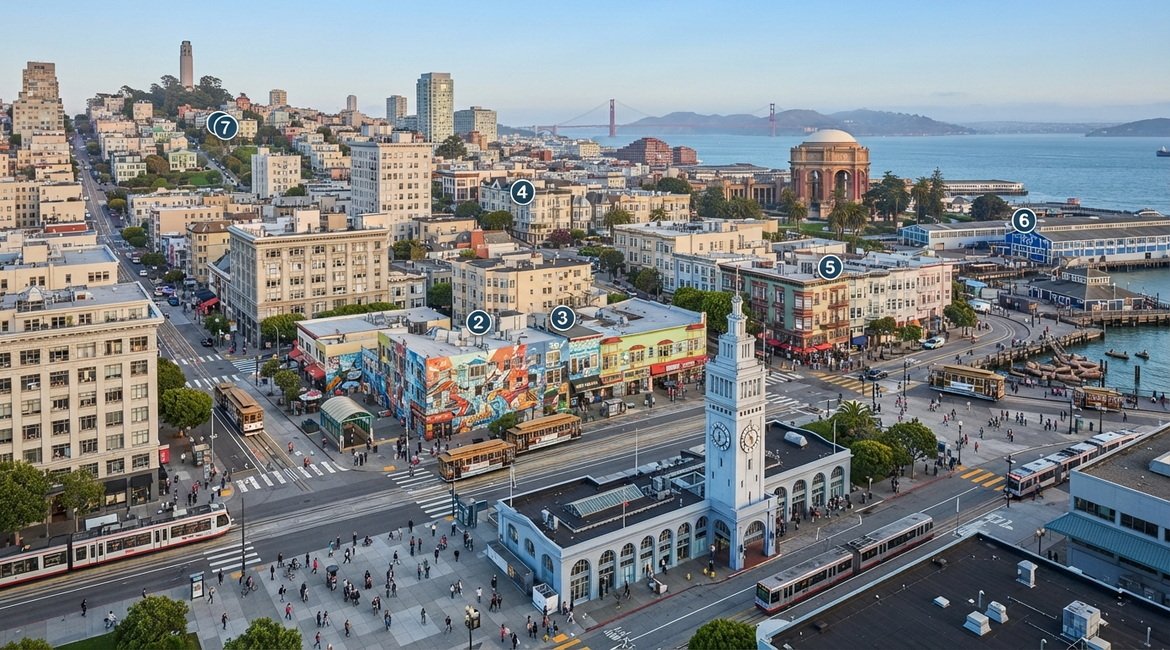
San Francisco is one of the easier major U.S. cities to explore without renting a car. The city is relatively compact, many major visitor areas are walkable, and an extensive public transportation network connects Downtown with neighborhoods, parks and waterfront attractions. For visitors, the bigger decision is not whether to rent a car but where to stay. Choosing the right neighborhood can make it possible to walk to restaurants and attractions, take Muni to destinations across the city and use BART for convenient connections to San Francisco International Airport and other parts of the Bay Area. Union Square is particularly practical for transportation. Fisherman’s Wharf puts many famous attractions within walking distance. Embarcadero combines waterfront access with strong transit connections, while North Beach provides a more neighborhood-oriented experience close to several classic sights. The best choice depends on what you plan to do each day.
Can You Stay in San Francisco Without a Car?
Yes. For many first-time visitors, renting a car for the city portion of a San Francisco vacation is unnecessary. Muni operates buses, Metro trains, historic streetcars and San Francisco’s famous cable cars. BART provides additional regional transportation and is particularly useful for airport connections and trips outside the immediate city. Walking also plays a major role. Several visitor districts sit close enough together that sightseeing can naturally move from one neighborhood into another. For example, Chinatown, North Beach and parts of Downtown can be combined without a vehicle. Fisherman’s Wharf and the northern waterfront form another useful walking area. The main challenge is San Francisco’s hills. A destination may appear close on a map while still requiring a steep walk. Travelers with young children, strollers or limited mobility should consider terrain as well as distance.
Best Areas at a Glance
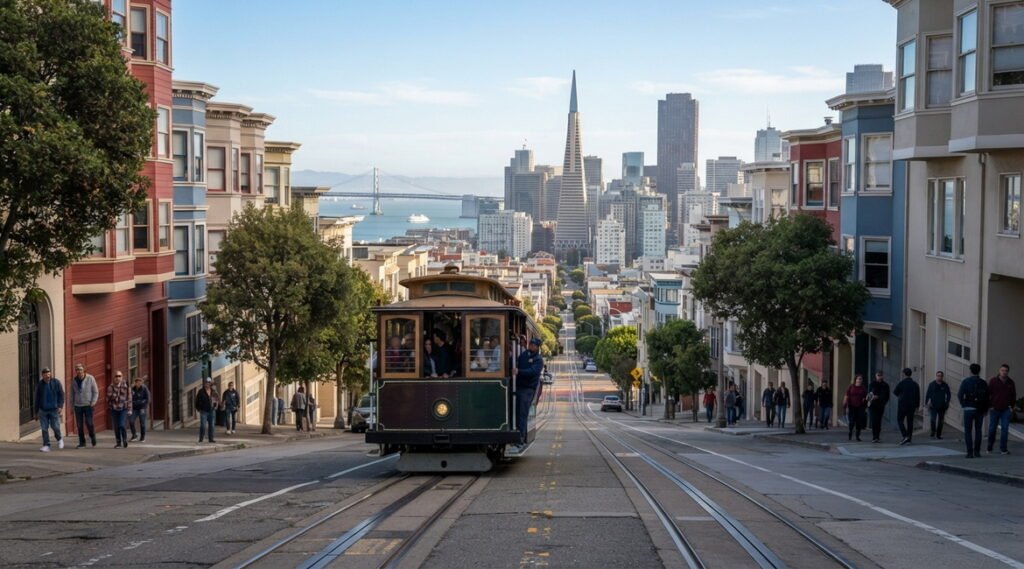
These seven areas provide different advantages for travelers visiting San Francisco without a car.
| Area | Useful For | Transit |
|---|---|---|
| Union Square | First visits, central location | Excellent |
| Fisherman’s Wharf | Families, classic attractions | Very good |
| Embarcadero | Waterfront, ferries, walking | Excellent |
| North Beach | Food, neighborhood atmosphere | Good |
| SoMa / Yerba Buena | Museums, Downtown access | Excellent in selected locations |
| Nob Hill | Classic San Francisco atmosphere | Good |
| Mission District | Food, local neighborhoods | Very good near BART |
There is no need to choose the neighborhood with the most attractions. A better strategy is choosing an area that combines useful transit with the kind of evenings and mornings you want near your hotel.
1. Union Square
Union Square is one of the most practical bases for a first San Francisco trip without a car. The neighborhood has one of the city’s largest concentrations of hotels and sits close to multiple forms of public transportation. Powell Street provides access to BART and Muni Metro, while cable cars connect the area with destinations toward Nob Hill and the northern waterfront. Market Street adds additional transit connections. That combination makes Union Square useful if your itinerary spreads across several parts of San Francisco. You can travel toward the Embarcadero, reach neighborhoods along Market Street, connect toward western parts of the city and use BART for airport transportation.
Chinatown is also within walking distance, while North Beach can be reached by continuing farther north. Union Square has a more urban Downtown atmosphere than neighborhoods such as North Beach or the Marina. For travelers prioritizing transportation over a residential neighborhood feel, that can be a worthwhile tradeoff.
2. Fisherman’s Wharf
Fisherman’s Wharf is particularly convenient for first-time visitors who want classic San Francisco attractions immediately outside the hotel. PIER 39, the waterfront and Ghirardelli Square are all in the general area. Boat departures and maritime attractions are also nearby. The neighborhood is relatively flat compared with many interior parts of San Francisco, which can make walking easier for families. Transportation is another advantage. The F historic streetcar connects Fisherman’s Wharf with the Embarcadero and Market Street, while cable car routes provide another connection toward central San Francisco.
The main consideration is atmosphere. Fisherman’s Wharf is one of San Francisco’s busiest visitor districts, so it can feel more tourist-oriented than neighborhoods farther from the waterfront. For a first trip with children or a short stay centered on famous attractions, that convenience may matter more.
3. Embarcadero & Financial District
The Embarcadero provides one of the easiest walking environments in central San Francisco. The waterfront is relatively flat, and the Ferry Building provides a useful landmark for orienting yourself. From here, you can walk north along the waterfront toward PIER 39 and Fisherman’s Wharf or explore Downtown in the opposite direction. Transit connections are excellent around the Embarcadero BART and Muni station. That makes this area particularly useful for travelers arriving from SFO by BART.
The waterfront is also useful for ferries and for travelers who enjoy morning or evening walks near the bay. The atmosphere changes somewhat after office hours in parts of the Financial District, so choosing accommodation close to the waterfront can provide a different experience from staying deeper among office buildings. For transportation plus waterfront access, the Embarcadero is one of the most practical combinations.
4. North Beach
North Beach works well for travelers who want to stay in a recognizable San Francisco neighborhood rather than a large Downtown hotel district. Restaurants, cafés and compact streets make the area enjoyable for exploring on foot. Chinatown sits immediately nearby. Fisherman’s Wharf is also within walking distance for many visitors, allowing you to reach several major sightseeing areas without using transportation.
North Beach does not have the same direct BART access as Union Square or the Embarcadero. Muni buses and nearby transit connections therefore become more important. Hills are another consideration. The neighborhood’s location makes some walks steeper than the flat waterfront. For travelers who value restaurants, atmosphere and walking between North Beach, Chinatown and Fisherman’s Wharf, it can still be an excellent car-free base.
5. SoMa & Yerba Buena
SoMa covers a large area, so location matters more here than in some smaller neighborhoods. The most useful sections for visitors without a car are generally those close to Market Street, Yerba Buena and convenient transit. This places you near several museums and cultural attractions while maintaining access to Muni and BART. Yerba Buena Gardens provides a useful central reference point, with major museums and Downtown destinations nearby.
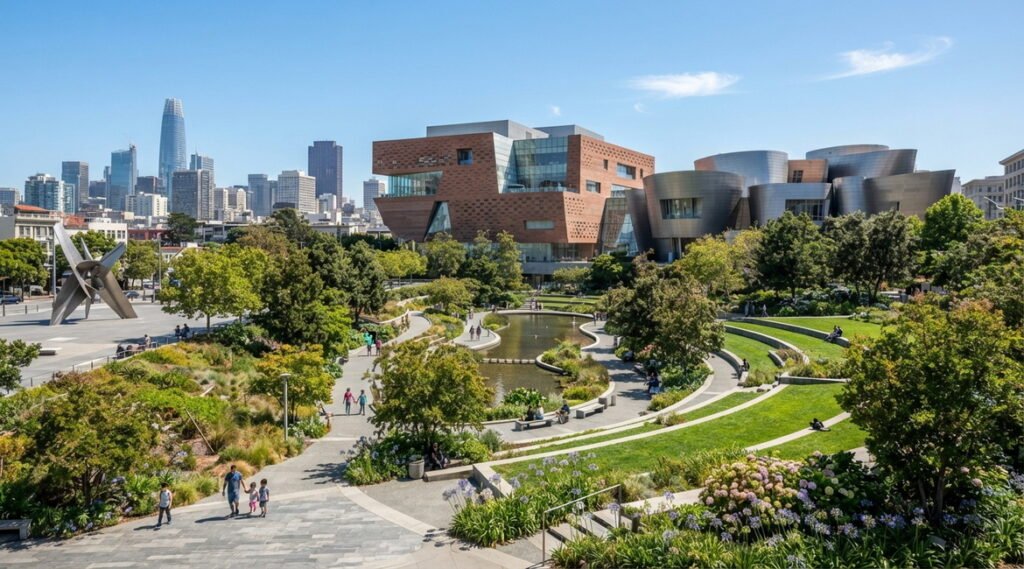
SoMa can also work for travelers attending events in the area. However, do not book accommodation simply because the listing says “SoMa.” Check the exact location and the nearest transit stop. Because the district is large, two hotels both described as being in SoMa can provide very different experiences for a visitor without a vehicle.
6. Nob Hill
Nob Hill provides a classic San Francisco setting. Historic architecture, city views and cable cars help create the kind of atmosphere many first-time visitors imagine before arriving. Its central location puts Union Square, Chinatown and other central neighborhoods relatively close. The obvious disadvantage is contained in the neighborhood’s name: the hill.
Walking downhill may be easy; returning to the hotel can feel very different. Cable cars and buses help, but travelers with strollers or mobility limitations should examine the exact hotel location carefully. Nob Hill can work extremely well without a car if hills are not a concern and you want a more traditional San Francisco experience.
7. The Mission
The Mission District provides a different experience from the main tourist hotel districts. This is a strong option for travelers interested in restaurants, neighborhood exploration and spending more time outside the traditional Downtown sightseeing corridor. BART stations around 16th Street and 24th Street provide useful regional connections. Muni buses add connections to other parts of San Francisco. The Mission also tends to experience sunnier conditions than some neighborhoods closer to the Pacific.
The disadvantage for first-time visitors is distance from some classic waterfront attractions. You will rely on transit more frequently than if you stay at Fisherman’s Wharf or the Embarcadero. For repeat visitors or travelers who prioritize neighborhood atmosphere and dining over waking up beside famous attractions, the Mission can be an interesting base.
Which Area Is Best for First-Time Visitors?
For a first San Francisco trip without a car, Union Square, Fisherman’s Wharf and the Embarcadero are particularly practical places to start your hotel search. They solve different problems.
| Priority | Area to Consider |
|---|---|
| Central transportation | Union Square |
| Classic attractions nearby | Fisherman’s Wharf |
| Waterfront + BART | Embarcadero |
| Neighborhood atmosphere | North Beach |
| Museums + Downtown | Yerba Buena / SoMa |
| Classic hills + cable cars | Nob Hill |
| Food + local neighborhood feel | Mission District |
If you expect to visit attractions across many different parts of the city, prioritize transit. If most of your itinerary is concentrated around the northern waterfront, staying there can reduce the amount of transportation you need in the first place.
Where to Stay Without a Car With Kids
Fisherman’s Wharf is especially practical for many families. PIER 39, the waterfront, Ghirardelli Square and several attractions are nearby, which means families can complete parts of their itinerary entirely on foot. The relatively flat waterfront is another advantage when using a stroller.
Union Square provides a different advantage: transportation. Families planning to explore several areas of San Francisco can use nearby Muni, BART and cable car connections rather than repeatedly relying on rideshares. The Embarcadero is another useful option for families who prefer flatter walking routes and waterfront access. With children, consider the distance from the hotel entrance to the actual transit stop rather than simply choosing a neighborhood described as “central.” A few blocks can feel much longer when they involve steep hills, luggage or a stroller.
Best Area for BART Access
If BART is important to your trip, staying near Market Street provides some of the most convenient options. Powell Street is useful for Union Square. Montgomery Street serves the Downtown and Financial District area, while Embarcadero provides convenient access to the waterfront. Civic Center is another central station, although travelers should evaluate their exact hotel location and itinerary rather than selecting accommodation based on a station name alone. The Mission has BART access farther south through stations at 16th Street and 24th Street. BART is particularly useful when arriving from San Francisco International Airport. Inside the city itself, however, Muni will often be more important for sightseeing.
Best Area for Walking
San Francisco is highly walkable in many areas, but its famous hills make simple walkability scores less useful than they might be elsewhere. The waterfront is one of the easiest places for long, relatively flat walks. Fisherman’s Wharf and the Embarcadero therefore work particularly well for travelers who want to explore on foot without repeatedly climbing steep hills. North Beach is highly walkable in terms of attractions, restaurants and nearby neighborhoods, but elevation changes become more noticeable. Union Square is central enough to walk to Chinatown and Downtown attractions, while transit can handle longer trips.
Do not underestimate the hills when planning walking times. A route that looks short on a map can be more tiring than a longer flat route along the waterfront.
Areas That Require More Planning Without a Car
Staying farther west can still work without a car, but it changes the trip. The Richmond and Sunset districts provide access to Golden Gate Park, residential neighborhoods and the Pacific side of San Francisco. However, visitors planning to spend most days around Downtown, Chinatown and Fisherman’s Wharf will generally spend more time on transit. The Presidio provides spectacular scenery and access to major outdoor attractions but is not as directly connected to BART or Muni Metro as central neighborhoods. The Marina is attractive for the northern waterfront and Golden Gate Bridge side of the city, but it does not have direct BART service. None of these areas requires a rental car. They simply require more careful transit planning if your sightseeing priorities are spread across San Francisco.
How to Get Around San Francisco Without a Car
Most visitors will use several transportation methods rather than relying on only one. Muni is the primary system for traveling within San Francisco. Its network includes buses, Metro trains, historic streetcars and cable cars. BART is more useful for selected trips along its city corridor and for regional connections. Walking can cover surprisingly large portions of central San Francisco. The F historic streetcar is especially useful for visitors because it follows Market Street and the Embarcadero toward Fisherman’s Wharf. Cable cars are both transportation and part of the classic San Francisco experience.
As of September 2026, adult riders can also tap a chip-enabled contactless debit or credit card on Muni fare readers. Visitor Passports remain available for 1, 3 and 7 days. Before buying a multi-day pass, compare its current price with the number and type of rides you actually expect to take. Cable car fares are particularly relevant because fare rules differ from ordinary Muni trips.
Getting From SFO Without a Car
Travelers arriving at San Francisco International Airport can reach central San Francisco without renting a car. BART connects SFO with stations along the Market Street corridor. This is particularly convenient if your accommodation is near Powell Street, Montgomery Street, Embarcadero or another location with an easy connection from BART. If you are staying at Fisherman’s Wharf, you can continue from the central city using local transportation or use a rideshare or taxi for the final portion. Travelers carrying substantial luggage may prefer the simplest final connection rather than choosing a route based solely on price. For a car-free trip, airport access is one reason Union Square, Downtown and the Embarcadero are so convenient.
Do You Save Money by Skipping a Rental Car?
Potentially, but the answer depends on your itinerary. A rental car involves more than the advertised daily rate. Parking at a hotel, attraction parking, fuel and other expenses can increase the total cost. Without a car, your transportation budget may instead include Muni, BART and occasional rideshares. For a trip concentrated entirely within San Francisco, public transportation and walking can often handle most sightseeing needs. The calculation changes if San Francisco is only one part of a larger California road trip. In that situation, consider renting the car when you are ready to leave San Francisco rather than paying to keep it parked during several city sightseeing days.
FAQ
Do tourists need a car in San Francisco?
Many visitors do not need one. Walking, Muni and BART can cover a large portion of a typical first-time itinerary. A car becomes more useful when San Francisco is part of a wider California road trip or your plans include destinations outside the city that are less convenient by public transportation.
What is the most convenient area without a car?
Union Square is especially convenient for travelers who expect to use several forms of public transportation because it is close to Muni, BART and cable car connections. Fisherman’s Wharf may be more convenient when your priority is having major tourist attractions within walking distance.
Is Fisherman’s Wharf convenient without a car?
Yes. Many waterfront attractions are within walking distance, and the area is served by the F historic streetcar, cable cars and buses. It is particularly convenient for first-time visitors and families who plan to spend significant time around the northern waterfront.
Can you get around San Francisco with kids without a car?
Yes. Families can combine walking with Muni and occasional rideshares. Fisherman’s Wharf is particularly useful because several family attractions are close together, while Union Square provides stronger connections for families planning to explore different parts of the city.
Is it better to stay near BART or Muni?
For sightseeing within San Francisco, Muni generally reaches more visitor destinations. BART is particularly useful for SFO airport access and regional travel. A hotel near both systems, such as one around the Market Street corridor, provides the greatest flexibility.
Recommended Next Steps
Start by marking the attractions you consider essential on a map. If they are spread across San Francisco, look first at Union Square or another well-connected location around the Market Street corridor. If your trip centers on PIER 39, waterfront attractions and classic first-time sightseeing, Fisherman’s Wharf can reduce the number of transportation trips you need each day. For waterfront walks combined with excellent central transit connections, consider the Embarcadero. North Beach works well when neighborhood atmosphere, restaurants and walking matter more than having BART immediately outside your hotel. Families should pay particular attention to hills and the actual distance between a hotel and the nearest useful transit stop. You generally do not need to rent a car simply to explore San Francisco. Instead, choose your accommodation around the transit lines and attractions you expect to use most frequently. If San Francisco is the beginning of a California road trip, another practical strategy is to explore the city without a vehicle and pick up your rental car only when you are ready to leave.