
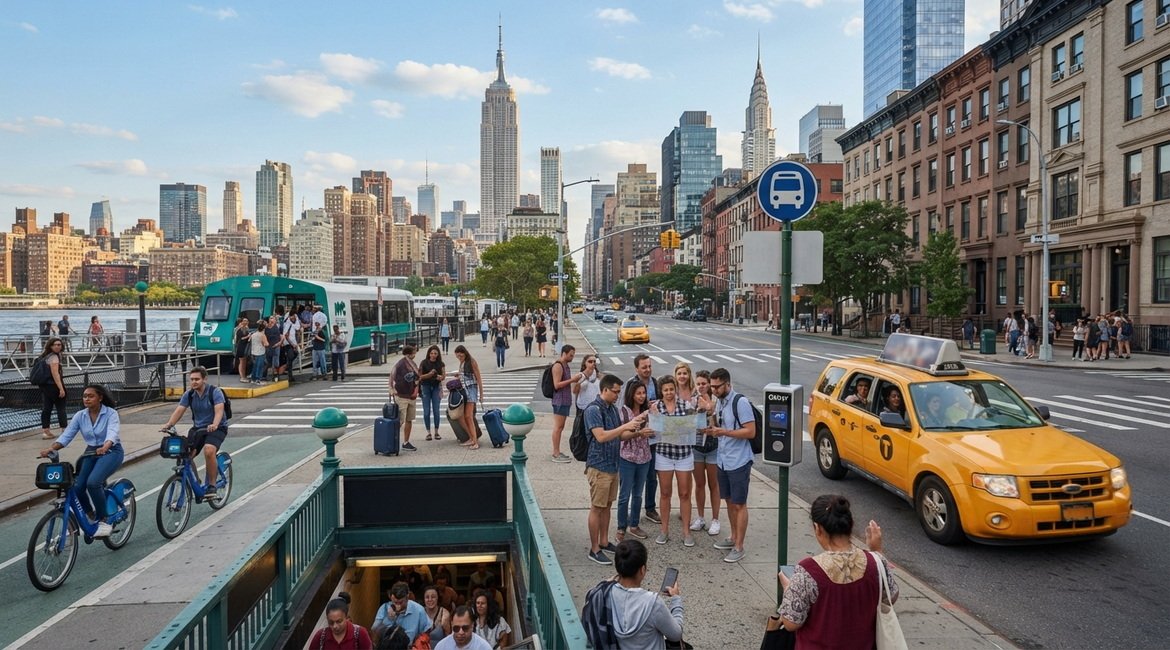
Getting around New York City can look complicated when you first see the subway map, but transportation becomes much easier once you understand a few basic rules. For most tourists, the best strategy is a combination of subway rides and walking. Use the subway for longer distances, then explore individual neighborhoods on foot. Buses can be useful for shorter trips and crosstown routes, while taxis are convenient when you have luggage or when public transportation would require an awkward combination of transfers. Ferries provide another option in certain parts of the city and can turn transportation into part of the sightseeing experience. The most important thing is not finding one transportation method that works for every journey. New York is easier when you choose the right option for each trip. This guide explains the main transportation choices, how to pay for subway and bus rides, and how first-time visitors can move around New York without making transportation more complicated than necessary.
What Is the Best Way to Get Around New York City?
For most visitors, the subway combined with walking is the most practical way to explore New York. The subway handles longer distances efficiently and reaches most areas that appear on a typical first-time itinerary. Walking handles everything in between. Instead of taking the subway for every short journey, use it to reach a neighborhood and then explore that part of the city on foot. Buses become particularly useful when a route matches your destination well or when you prefer remaining above ground. Taxis can solve specific problems, especially when traveling with luggage, late in the day or between places that are inconveniently connected by public transportation.
| Situation | Practical Choice |
|---|---|
| Long Manhattan trip | Subway |
| Exploring one neighborhood | Walking |
| Crosstown journey | Bus, subway or taxi depending on route |
| Traveling with heavy luggage | Taxi or convenient direct transit route |
| Manhattan to popular Brooklyn areas | Subway |
| Waterfront route | Ferry when convenient |
NYC Transportation at a Glance
New York has several transportation systems, but tourists do not need to master all of them. The subway and local buses form the core of everyday public transportation. Walking covers a surprising amount of sightseeing, particularly when you organize attractions geographically. Taxis provide convenient door-to-door transportation at a higher cost. NYC Ferry connects selected waterfront neighborhoods, while the Staten Island Ferry provides a separate free service between Lower Manhattan and Staten Island. Regional rail systems such as Long Island Rail Road, Metro-North and NJ Transit become more relevant for airports, outer destinations and trips beyond the areas typically covered by the subway.
How to Use the NYC Subway
The subway looks intimidating because there are many lines, stations and transfer points. For a tourist, however, you only need to answer three questions before boarding. Which station are you entering? Which direction are you traveling? Where do you need to get off? Navigation apps can handle much of the route planning, but always compare the suggested route with the signs inside the station before boarding.
In Manhattan, directions are often described as uptown and downtown. Uptown generally means traveling north through Manhattan, while downtown means traveling south. Other lines may instead use destination or borough names. The entrance you choose matters because some stations have entrances that lead directly to one direction of travel. Do not rush through the turnstile until you have checked that you are entering the correct side.
How OMNY Works for Tourists
OMNY is the MTA’s tap-and-go fare payment system. Visitors can pay at subway turnstiles and on local buses using an accepted contactless payment method or an OMNY card. As of 2026, the base fare for a subway or local bus ride is $3. One of the easiest approaches for many visitors is simply using the same contactless payment method throughout the trip. This is particularly important if you want eligible rides to count toward OMNY’s weekly fare cap. Do not switch randomly between several cards, phones and other payment methods if you expect all rides to count together. Each traveler should also have an appropriate way to pay rather than assuming one payment method will automatically provide fare-capping benefits for an entire group. Fare policies can change, so verify current MTA rules shortly before traveling.
Local vs Express Subway Trains
Understanding local and express service prevents one of the most common first-time subway mistakes. A local train stops at every station along its route. An express train skips selected stations to travel longer distances more quickly. This can save time when your destination is an express stop. It can also take you straight past your destination if you board the wrong train. Do not assume that every train stopping on the same platform makes the same stops. Check the route and destination before boarding. If you accidentally board an express train, there is usually no reason to panic. Get off at the next appropriate station and adjust your route.
Getting Around by Bus
Visitors sometimes ignore New York buses because the subway appears faster and easier to understand. But buses can be very useful. They are particularly practical for certain crosstown journeys in Manhattan where subway lines primarily run north and south. They also allow you to remain above ground and see the city while traveling.
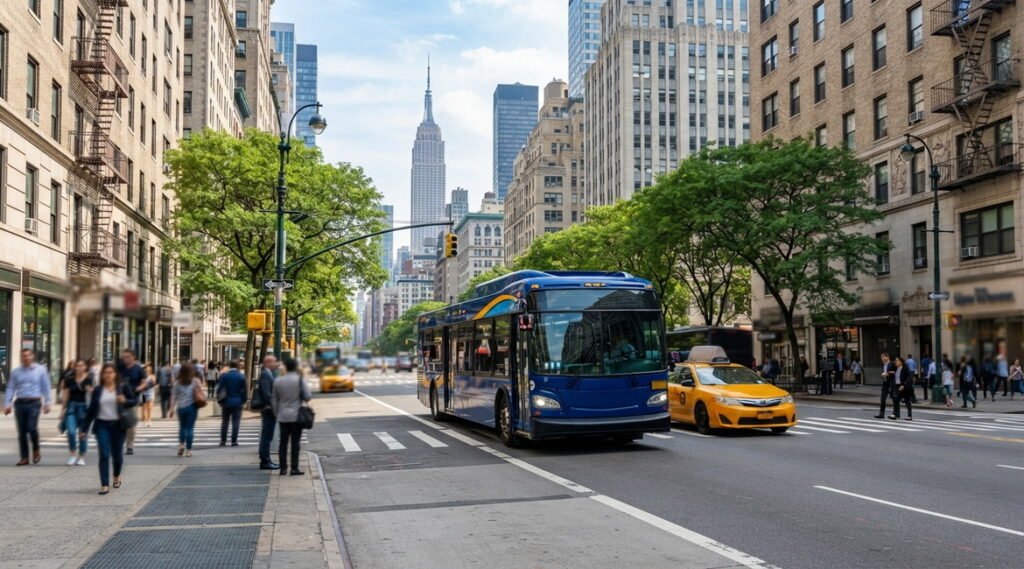
The main disadvantage is traffic. A short bus journey can take considerably longer during busy periods. Use buses when the route is convenient rather than assuming they are always faster than walking or taking the subway. OMNY also simplifies payment because the same general tap-and-go approach used for the subway applies to local buses.
Walking Around New York City
Walking is not merely a way to save transportation money. It is one of the best ways to experience New York. Neighborhoods can change noticeably within a relatively short distance. Walking from Chelsea toward Greenwich Village provides a completely different experience from traveling underground between two stations. The same applies to Midtown, SoHo, the Upper West Side and Lower Manhattan.
The mistake is assuming that because New York is walkable, everything is close. Manhattan is large. Several short-looking map segments can easily turn into miles of walking over the course of a day. Use walking for neighborhood exploration and the subway for larger jumps between sightseeing areas. Comfortable shoes are one of the most useful things you can bring to New York.
Taxis & Rides
Taxis can be useful without becoming your primary transportation method. They make particular sense when carrying luggage or traveling between two places that would otherwise require inconvenient transfers. A taxi can also be helpful at the end of a long sightseeing day when everyone is tired.
The tradeoff is cost and traffic. A car journey across Manhattan is not automatically faster than the subway. During congested periods, the opposite may be true. Treat taxis as a useful option rather than the default choice. When several people are traveling together, comparing the convenience of one vehicle with multiple individual transit journeys can sometimes make sense.
NYC Ferry
NYC Ferry connects a number of waterfront locations across the city’s boroughs. For tourists, it can be particularly useful when both the starting point and destination are close to ferry landings. The East River routes can also provide an enjoyable alternative perspective of Manhattan, Brooklyn and Queens.
Do not confuse NYC Ferry with the Staten Island Ferry. They are separate services with different routes and fare structures. NYC Ferry requires a paid ticket. As of September 2026, its standard adult one-way fare is $4.50, and schedules vary by route and season. The ferry is therefore usually best treated as a transportation option that also provides sightseeing value rather than as the cheapest way to move around the city.
Staten Island Ferry
The Staten Island Ferry is different. It operates between Whitehall Terminal in Lower Manhattan and St. George Terminal on Staten Island. The service is free. The crossing takes approximately 25 minutes each way and operates every day throughout the year.
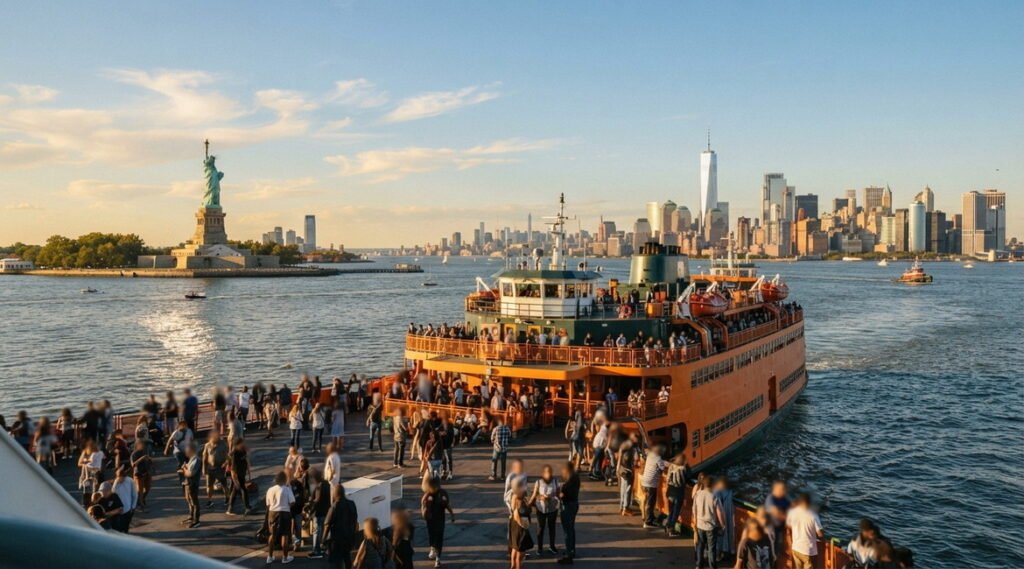
For tourists, it can serve two purposes. It provides actual transportation to Staten Island while also offering views of New York Harbor and the Statue of Liberty. It does not stop at Liberty Island. If your goal is to visit the Statue of Liberty itself, you need the appropriate dedicated ferry service instead. But if you simply want a harbor ride and distant views of the statue, the free Staten Island Ferry is a useful addition to a Lower Manhattan day.
Getting Between Manhattan & Brooklyn
The subway is usually the easiest option. Multiple lines connect Manhattan with different parts of Brooklyn, so the correct route depends on where you are going. For first-time visitors, DUMBO and Brooklyn Heights are particularly popular. One enjoyable strategy is to travel in one direction by subway and return partly on foot across Brooklyn Bridge.
Brooklyn is much larger than the waterfront neighborhoods visible from Manhattan. Do not assume that every Brooklyn destination is within walking distance of Brooklyn Bridge. Use the subway when exploring areas farther into the borough.
Getting Between Manhattan & Queens
Queens is also well connected with Manhattan by subway. This becomes especially relevant for visitors staying in Long Island City. Depending on your exact station and destination, the journey into Midtown can be relatively straightforward. Queens also contains major destinations that require their own transportation planning rather than simply being treated as an extension of Manhattan. The subway remains the primary option for many tourist journeys, while buses, taxis and regional rail can become useful depending on the destination. If your hotel is in Queens, look at the specific subway line near the property before booking. Distance from Manhattan on a map matters less than the quality of the transportation connection.
Getting From NYC Airports to the City
New York’s three major airports require different transportation strategies. JFK Airport has public transportation connections that can be combined with subway or rail service into the city. LaGuardia relies on bus connections for public transportation, with onward subway or rail options depending on the route. Newark Liberty International Airport is in New Jersey and has rail and road transportation options into the New York area.
There is no single airport transportation method that is best for everyone. A solo traveler with light luggage may prefer public transportation. A family with several suitcases may decide that direct transportation is worth the additional cost. Your arrival time also matters. Always check current airport transportation service shortly before traveling because construction, service changes and temporary disruptions can affect the most convenient route.
Getting Around NYC With Kids
Families can use essentially the same transportation strategy as other visitors: subway plus walking. The difference is pace. Children may become tired sooner, particularly when a sightseeing day combines long walks with repeated station stairs. Not every subway station provides the same level of step-free accessibility. When traveling with a stroller or when elevators are important, check the stations on your planned route rather than assuming every entrance is equally accessible.
Buses can sometimes provide a useful alternative because they avoid navigating underground stations. Taxis can also be valuable for specific journeys, particularly when everyone is tired or you are carrying luggage. Do not schedule a family trip according to the fastest possible adult walking pace. Transportation time should include realistic breaks.
Getting Around With Luggage
A route that works perfectly during a sightseeing day may be frustrating with two suitcases. Station stairs, crowded trains and longer walks between the station and hotel become much more noticeable when carrying luggage. Before choosing public transportation from an airport or train station, look at the entire journey. How many transfers are required? Does the route involve a long walk? Are elevators important? How far is your hotel from the final station? A direct taxi may cost more but provide better value when several travelers are splitting the ride and carrying multiple bags. Once you have checked into the hotel, switch back to subway and walking for normal sightseeing.
Do Tourists Need a Rental Car?
Most tourists do not need a rental car for a typical New York City vacation. The subway, buses, walking, taxis and ferries cover the vast majority of situations visitors encounter. Keeping a car in Manhattan also introduces parking costs and traffic. A vehicle becomes more useful when New York is only one part of a larger road trip. If you plan to spend four days in Manhattan and then drive into another region, consider renting the car when you are ready to leave the city rather than keeping it throughout your New York stay. For a city-only trip, public transportation is generally the simpler strategy.
How to Plan Each Sightseeing Day
The easiest way to reduce unnecessary transportation is to group attractions geographically. Spend one day or half-day around Midtown. Use another for Central Park and a nearby museum. Combine the High Line with Chelsea and Greenwich Village. Keep Lower Manhattan, Brooklyn Bridge and DUMBO together.
| Sightseeing Area | Useful Transportation Strategy |
|---|---|
| Midtown | Walk between nearby sights |
| Central Park | Subway there, then walk |
| Chelsea & Greenwich Village | Mostly walking |
| Lower Manhattan | Subway there, then walk |
| Brooklyn Bridge & DUMBO | Subway + walking |
| Long Island City | Subway or ferry depending on route |
This approach reduces unnecessary backtracking and lets transportation support the itinerary rather than dominate it.
Common NYC Transportation Mistakes
One of the most common mistakes is boarding a subway train without checking its direction. Another is assuming that a train stopping on your platform must stop at your destination. Check whether you need local or express service. Do not underestimate walking distances. Ten blocks here and another fifteen blocks later can turn into a substantial amount of walking by the end of the day. Avoid taking taxis for every journey simply because they seem easier. Traffic can make a taxi slower than the subway while also costing considerably more. Do not assume every subway station has an elevator. This is particularly important for travelers using wheelchairs, mobility devices or strollers. Finally, check service information rather than assuming the subway always follows the route you used earlier in the week. Maintenance and other service changes can affect routes, particularly outside the busiest weekday periods.
FAQ
What is the easiest way for tourists to get around NYC?
For most tourists, combining the subway with walking is the easiest strategy. Use the subway for longer distances between neighborhoods and explore individual sightseeing areas on foot.
How much is the NYC subway in 2026?
As of 2026, the base subway and local bus fare is $3. Visitors can use OMNY to tap and pay for eligible subway and bus journeys.
Can tourists use OMNY?
Yes. Tourists can use OMNY with an accepted contactless payment method or OMNY card. Using the same payment method consistently is important when you want eligible rides to count toward fare capping.
Is the NYC subway difficult for first-time visitors?
The system can look complicated at first, but most visitors become comfortable after a few rides. Focus on your line, direction, destination station and whether the train is local or express rather than trying to memorize the entire subway map.
Do you need a car in New York City?
Most visitors do not need a car. Subway service, buses, walking, taxis and ferries cover typical tourist itineraries. If New York is the beginning of a road trip, consider renting the vehicle when you are ready to leave the city.
Recommended Next Steps
For your first New York trip, keep transportation simple. Use the subway as your main method for traveling longer distances and walk once you reach the neighborhood you want to explore. Use OMNY consistently rather than changing payment methods throughout the trip. Learn the difference between uptown and downtown before your first subway journey, then pay attention to local and express service. Use buses when they provide a convenient direct route, particularly for certain crosstown journeys. Treat taxis as a useful tool for luggage, tired travelers or inconvenient routes rather than your default transportation. Consider NYC Ferry when it connects two waterfront areas that already fit your itinerary, and add the free Staten Island Ferry to a Lower Manhattan day if you want to experience New York Harbor. Group attractions geographically so you are not repeatedly crossing the city. Most importantly, do not try to master the entire transportation network before your vacation. You only need to understand the route in front of you. After a few subway rides and neighborhood walks, getting around New York usually becomes a normal part of the trip rather than something you need to worry about.