

Researching several states can turn into a trail of saved articles, map pins, and half-remembered recommendations. A simple system for multi-state US travel guide research keeps useful details connected: what you want to see, how each stop fits the route, and which facts need checking again before departure.
Set the boundaries for your multi-state research
Before collecting destinations, write down your likely travel dates, starting point, trip length, and top priorities. You might be planning around history, landscapes, food, or a mix. These boundaries help you judge whether a suggestion fits, rather than adding every appealing place to a growing list.
Choose one planning workspace, such as a document or spreadsheet, and use it as the home for notes and links. Maps can help you visualize distances, but they should support your plan rather than become the only place where important details live.
If you are still deciding which parts of the country belong in the trip, start with the broader Travel Destinations USA planning guide. Then return to your notes and define a manageable research area.
Create one trip record for every state
Set up a section or tab for each state you may visit. For every one, record candidate destinations, why they interest you, the relevant links, and questions you have not answered yet. Add a shared route section for ideas that cross state lines, such as a regional drive or a connected group of historic sites.
Give each note a clear status:
- Confirmed: a detail checked against a current, appropriate source.
- Needs checking: useful information that may be old or incomplete.
- Idea: a place or activity to investigate, not a commitment.
This structure makes online travel guides easier to use: save the specific page or section that supports an idea, not only the guide’s homepage. In multi-state research, a saved recommendation without its location or source can become difficult to interpret later.
Separate must-haves from ideas to investigate
Mark fixed needs separately from optional possibilities. A must-have might be a particular destination, a reasonable daily driving limit, or time for a family visit. Ideas to investigate might include a scenic stop, a local museum, or a small-town detour.
For each idea, write one sentence about why it may belong. “It is near the route and adds a history stop” is more useful than “looks interesting.” If you cannot explain how a place supports your priorities, leave it in the idea pool instead of fitting it into the itinerary prematurely.
A common pitfall is treating a long list of saved places as a plan. Keep a shortlist, but do not decide how many stops to include until you have compared route time and time needed at each destination.
Choose reliable sources for each research question

Use different sources for different jobs. Editorial travel guides can help you discover places and understand their appeal. Official government, park, transport, and destination sources are better suited to checking current rules, access, schedules, or closures.
This source hierarchy helps you get value from united states travel guides without treating every detail as equally current. When two sources disagree, note the difference and check a current source that is responsible for the relevant information.
For deeper context on history, culture, and what a guide can offer, see United States travel guides for deep research. Then use official sources to confirm practical details that could affect your dates or route.
Check official sources for rules and current conditions
When a detail could change whether or how you visit, look for the organization responsible for that detail. For example, check a park’s official page for access information, a transport provider for its current service details, and a destination’s official site for local visitor information.
Record what the source confirms, the page link, and when you checked it. If the information is unclear, keep the question open rather than turning an assumption into a fixed itinerary item. The relevant source may differ by place, so verify each stop rather than assuming one state’s arrangements apply across the border.
Use travel guides to discover and compare places
Use travel guides to find places that match your interests, understand their regional context, and compare the kinds of experiences available. Read beyond short summaries when you need history, cultural context, or a sense of what a visit involves. Look for practical information such as location, suggested visit length, and nearby attractions, but confirm time-sensitive logistics elsewhere.
Guides can help narrow the field; they do not have to make every decision for you. If coverage feels too broad or superficial, focus your research on the specific region and questions relevant to your trip. The history and culture destination guide can help you explore that angle across destinations.
Build a regional picture before comparing states

States are useful planning units, but a trip usually works better when you also consider the geography between them. Put candidate places on a map and look for clusters, natural corridors, and shared interests. A regional view can reveal that a nearby stop across a state line fits better than a distant attraction within the state you are researching.
The goal is not to cover every state or every famous sight. It is to build a connected trip around the places and experiences that matter most to you.
Group destinations by geography and trip interests
Start with the places that matter most, then group nearby candidates into possible route segments. A cluster might combine a city stay, a nearby historic site, and a landscape stop. Another might follow a stretch of coast or connect places with a shared cultural theme.
Label each cluster with the time it might need and the reason it fits. This helps you compare a regional route with a state-by-state list, which can sometimes encourage unnecessary backtracking. For ideas organized around the time of year, consult US travel destinations by season.
Note state-specific details that could change the plan
As you research, record differences that affect access, local transport, or the character of a stop. One destination may work well as a day visit from a nearby city; another may need its own overnight. Note whether your plan depends on a particular service, route, opening schedule, or access point, then check those details with a current source.
Do not assume that one state’s rules, transport options, or destination conditions apply in the next. Make state-specific questions visible in your notes so they do not disappear inside general regional research.
Connect state stops into a workable route
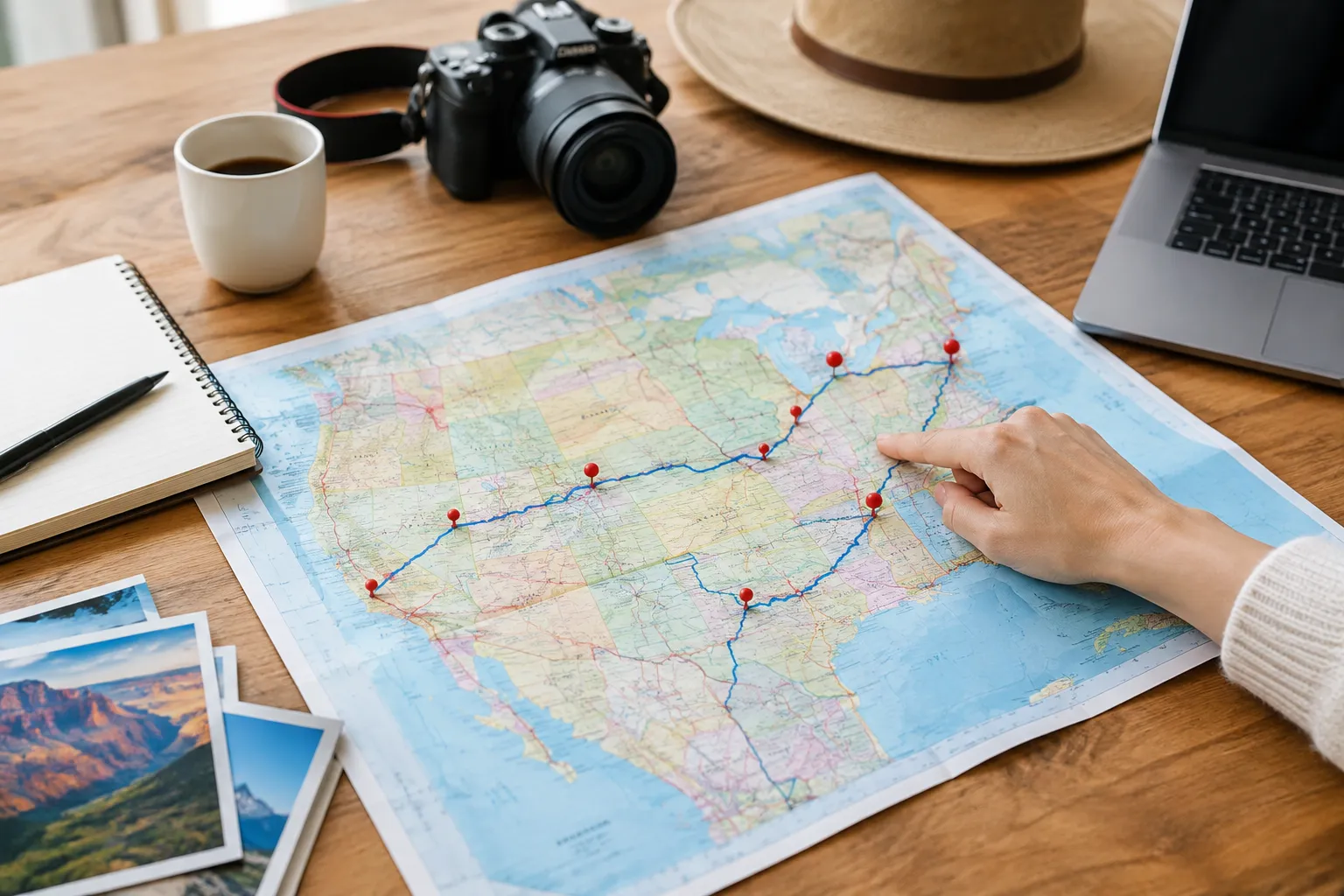
Once you have a regional picture, put the strongest candidates in a possible sequence. Consider where the trip begins and ends, which stops make sense next to one another, and whether the route includes repeated travel over the same ground.
A route is a working model, not a promise to visit every pin. Keep some flexibility until you have checked travel time, destination time, and current access.
Compare route options and travel time
Use a map or routing tool to compare the time between candidate stops. Treat estimated driving time as one part of the day, not the whole day: you may also need time for breaks, meals, arrival, and the visit itself. For public transport, check current schedules and the time needed to get to and from stations or stops.
Make a simple route comparison with columns for the next stop, estimated travel time, planned visit time, and overnight location. If one day appears crowded on paper, split it or remove a stop. Recheck the sequence for backtracking and for long travel days followed by demanding visits.
Look for useful stops between major destinations
Search for worthwhile breaks, meals, or overnights along the route rather than adding distant attractions just to fill a day. A stop is more likely to earn its place if it breaks up a long travel leg, fits your interests, or gives you time to explore an area you would otherwise pass through.
Before adding a detour, compare its added travel time with the time you would spend there. Keep the original route as an alternative until you know the detour’s access and timing work for your dates.
Recheck seasonal and time-sensitive details
A saved guide may remain helpful for context even when practical information needs another look. Revisit anything that could affect whether a stop is available, how you reach it, or how it fits into a particular day. Seasonal planning is especially relevant when your route crosses different regions or includes outdoor destinations.
For more on date-sensitive destination planning, use the seasonal US travel guide alongside your own checks.
Check opening dates, access, and local conditions
Before committing to a stop, look up current opening information, access details, and any relevant local conditions through an appropriate official source. Check again closer to the visit if the information is important to your plans. A destination appearing in a guide does not, by itself, confirm that it will be accessible during your travel dates.
If an essential stop has uncertain access, identify a nearby alternative. That gives the route a practical backup without requiring you to rebuild the entire trip if plans change.
Add a date to facts that may need refreshing
Include a “checked on” date beside details that can change, such as schedules, opening information, or access arrangements. Add a reminder to check again at a useful point in your planning, such as before you finalize the day-by-day outline or shortly before departure.
You do not need to recheck every piece of background reading. Prioritize facts that would change a booking, a travel day, or whether a stop belongs in the plan.
Use a research template to decide what earns time
A shared comparison template turns recommendations into decisions. For every candidate stop, record its location, appeal, estimated time needed, route impact, source, and what still needs checking. Add a decision field: keep, skip, or revisit.
This makes it easier to compare united states travel guides and online travel guides without letting the number of recommendations determine your itinerary. A strong candidate should fit your priorities and the route, not simply appear in several saved pages.
Compare value, effort, and fit
Assess each place against the same questions:
- What does it add to the trip?
- How much time might it need?
- How far does it pull the route away from its natural direction?
- Does it support a priority, such as history, culture, or scenery?
- Which important details remain unconfirmed?
A stop with a strong personal fit may be worth a longer journey. A place that adds little beyond another nearby option may be easier to skip. Record the reason for your choice so you can revisit it if dates or route plans change.
Turn the shortlist into a day-by-day outline
Arrange the strongest options into days, grouping nearby activities and allowing time for travel between them. For each day, note the main destination, any optional nearby stop, the expected overnight area, and details that still need checking.
Keep the outline flexible. Leave room to rest, extend a visit, or adjust the plan if a stop takes longer than expected. A useful itinerary gives each day a shape without requiring every hour to be filled.
Multi-State Trip Research FAQ
When should I start researching a multi-state trip?
Start once you know your approximate trip length and main priorities; that is enough to compare regions before dates are final. Recheck schedules, access, and other time-sensitive details when your dates firm up.
How can I keep trip research organized when several people are planning together?
Use one shared document or planning tool with a section for each state, a common shortlist, and a route map. Ask contributors to add links and mark suggestions as ideas, verified facts, or open questions.
What should I do when two travel guides give different advice?
Compare what each guide is discussing, then check current logistics with the relevant official source. Keep both perspectives in your notes if the difference concerns opinion or trip style rather than a verifiable detail.
How can I research a trip if my travel dates are not confirmed yet?
Research regional options, interests, and possible route sequences first, while flagging seasonal details and schedules for later checks. Avoid treating changeable opening or access information as settled until your dates are known.
How much unscheduled time should I leave in a long trip?
Leave some open time in each part of the trip rather than planning every day to capacity. The right amount depends on your pace, travel distances, and how much flexibility you want.
How can I tell whether a suggested detour is worth the extra travel time?
Compare the detour’s added travel time with the visit time and how strongly it matches your priorities. Keep it if the experience justifies the route change; otherwise, save it for another trip.
What is a simple way to save map links alongside my trip notes?
Paste each map link beside the relevant stop in your state record, then label it with the destination or route segment. This keeps the map connected to the reason you saved it.
How often should I revisit details I have already checked?
Revisit details when dates are confirmed, before finalizing the itinerary, and again closer to departure if they could affect access or timing. Use the source’s current information rather than relying on an old saved note.
Review the connected plan before booking
Before you move from research to bookings, read the route from beginning to end. Check that the dates, priorities, travel days, and overnight locations work together. Confirm that important logistics come from current sources and that each planned stop has enough time.
Then scan for common problems: backtracking, too many major visits in one day, a seasonal stop that still needs verification, or a detour whose value is unclear. Keep useful alternatives in your notes, but distinguish them from the main route.
A connected plan does not need to be exhaustive. It needs to show why each stop belongs, how you will get there, what still needs checking, and where you can adapt if circumstances change.